Unterfamilie Oxytelinae

ColeopteraStaphylinidae
By Gy. Makranczy (Rearranged by Arved Lompe)
Makranczy, Gy. (2006): Systematics and phylogenetic relationships of the genera in the Carpelimus group (Coleoptera: Staphylinidae: Oxytelinae). - Annales historico-naturales musei Nationalis Hungarici (Budapest), 98:29-120 >>>"F:\taxa\coleo\scans\Makranczy2006.pdf "
This key is not intended to be a practical identification guide, rather a systematic one, which helps workers determine whether a particular species belongs to a given genus or not. This goal can only be achieved by often relying on anatomical characters (necessitating permanent preparations or dissections). Since the superficial similarity between unrelated taxa can be great, it is unavoidable that less experienced workers examine at least a few of the key features of the genital segments, which can unequivocally determine the placement of a specimen. A more practical approach would require the use of external morphological characters that can vary and result in confusion - not counting the (great) possibility of previously unseen species possessing yet undiscovered character states.
#1
→ 2Abdominal segments III to VI with one pair of laterosclerites per segment. (Deleasterini)
→ 7-Abdominal segments III to VI with two pairs of laterosclerites per segment
#2
→ 3Procoxal fissure fully open. Tibia with longitudinal row of spines.
→ 4-Procoxal fissure nearly or quite closed. Tibia without longitudinal row of spines absent
#3
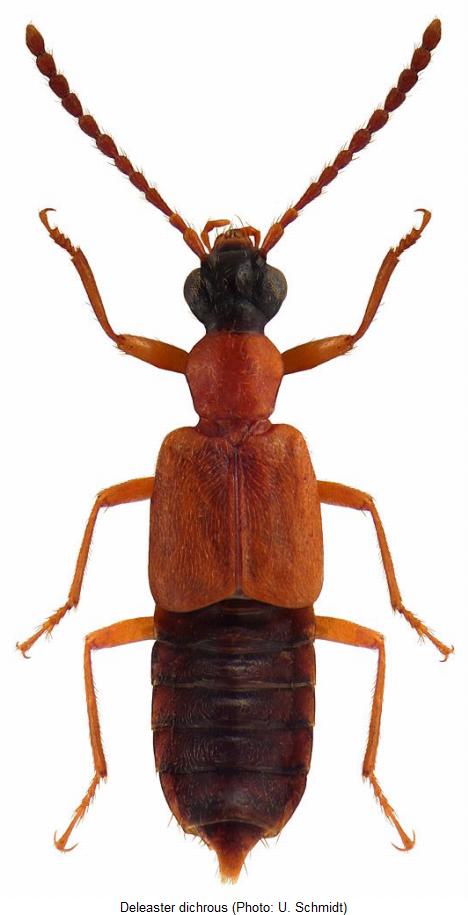
Deleaster Er.Pronotum distinctly convex in cross-section, laterally not margined; elytra without rows of punctures. Tergite VIII with serrate posterior margin. Body surface more or less dull. Habitus [Abb. 1].
deleaster_dichrous_hab.jpg
Abb. 1
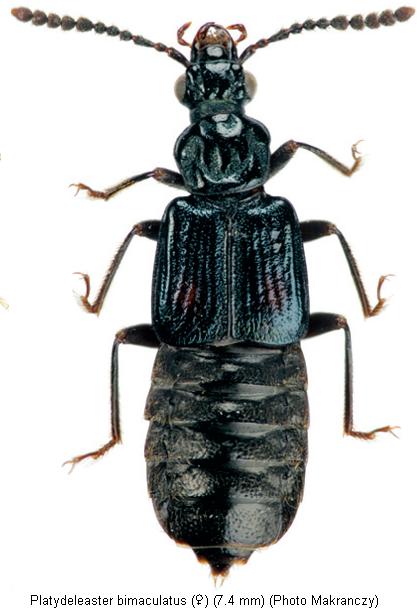
Platydeleaster-Pronotum flat and distinctly margined laterally; elytra with rows of punctures. Tergite VIII with smooth posterior margin. Body surface shining, except for the impressions and rows of punctures on head, pronotum, and elytra [Abb. 2]
platydeleaster_bimaculatus_hab.jpg
Abb. 2
#4
→ 5Body, especially dorsum, with numerous scale-like setae
→ 6-Body without scale-like setae
#5
OxypiusScale-like setae not plumose. Tarsal formula 5-5-5
Euphanias-Scale-like setae plumose. Tarsal formula 3-3-3
#6
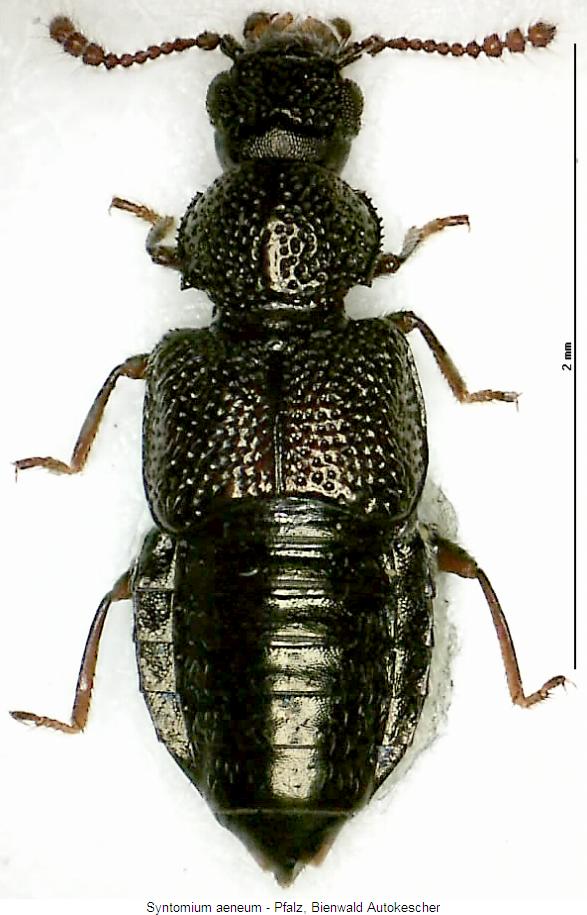
Syntomium Curt.Labrum with anterior margin emarginate. Elytra (from apex of scutellum) at least as long as pronotum. Habitus [Abb. 3].
syntomium_aeneum_hab.jpg
Abb. 3
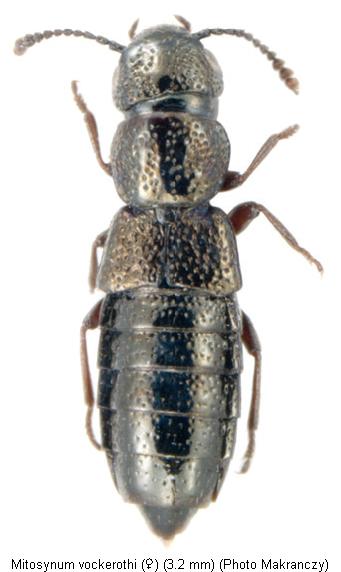
Mitosynum-Labrum with anterior margin broadly convex; elytra (from apex of scutellum) distinctly shorter than pronotum [Abb. 4]
mitosynum_vockerothi_hab.jpg
Abb. 4
#7
→ 8Reduced second sternite with a very short, immobile membranous connection to third sternite (hence only 6 complete sterna can be counted) (Coprophilini)
→ 10-Well developed second sternite articulated to third by a long connecting membrane (hence 7 complete sterna can be counted)
#8
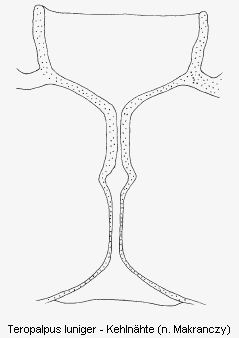
Coprophilus Latr.Gular sulci separated along entire length [Abb. 5]
teropalpus_luniger_kehlnaht.gif
Abb. 5
→ 9-Gular sulci confluent anteriorly
#9
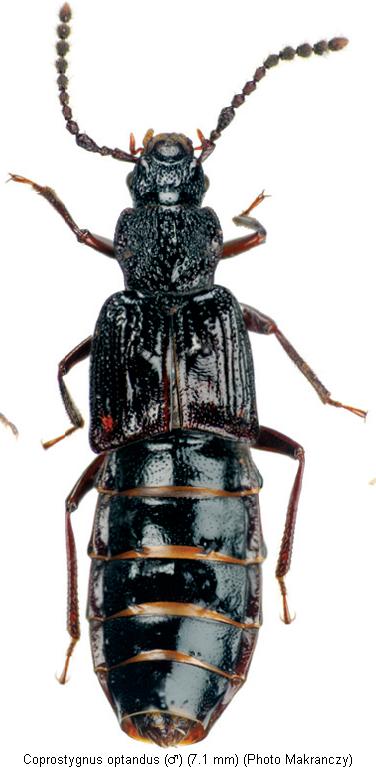
CoprostygnusEpistomal sulcus present [Abb. 6]
coprostygnus_optandus_hab.jpg
Abb. 6
Homalotrichus-Epistomal sulcus absent
#10
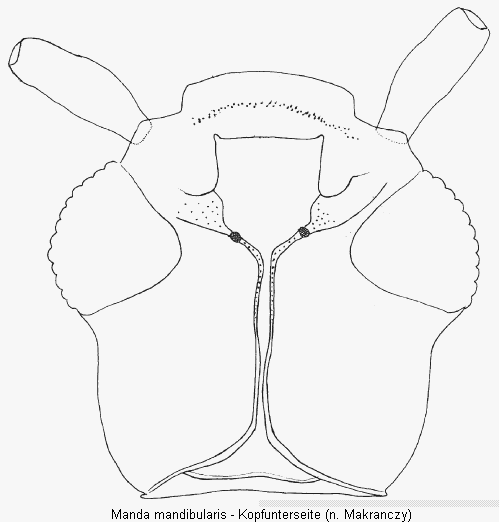
→ 11Eyes extending onto ventral portion of head [Abb. 7] (Planeustomini)
manda_mandibularis_kus.gif
Abb. 7
→ 12-Eyes not extending onto ventral portion of head
#11
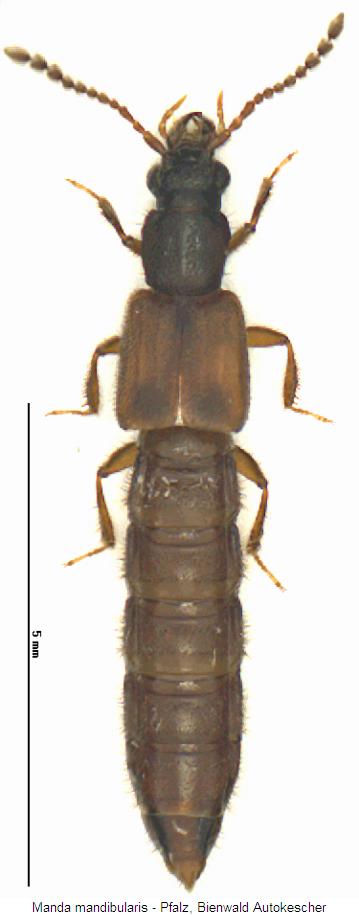
Manda Blackw. 1952Five distinct tarsomeres. Brick-wall pattern in intersegmental membrane. Habitus [Abb. 8].
manda_mandibularis_hab.jpg
Abb. 8
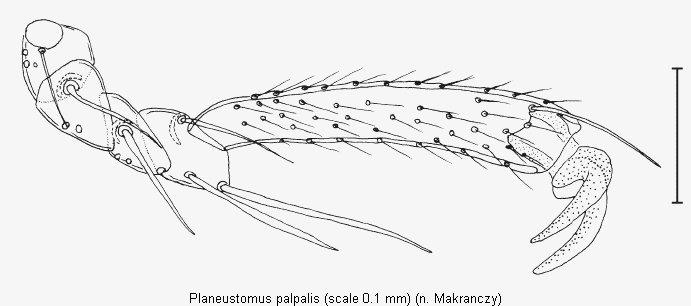
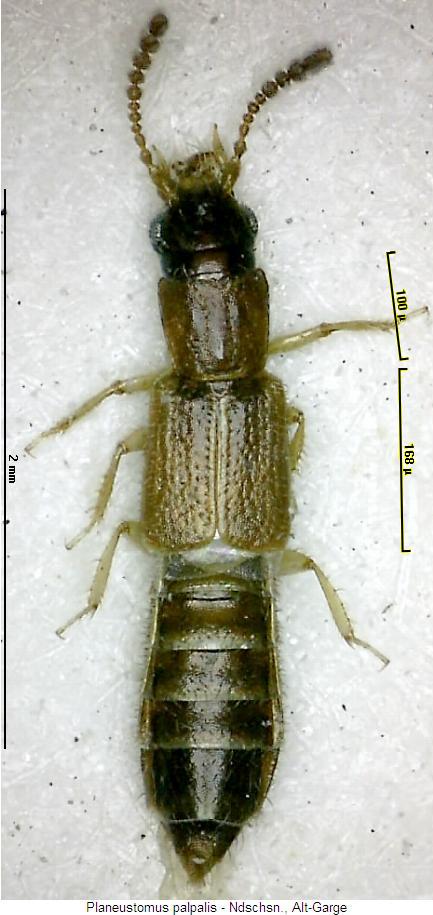
Planeustomus duVal-Four tarsomeres with additional non-setose pseudoarticle [Abb. 9], brickwall pattern in intersegmental membrane absent. Habitus [Abb. 10].
planeustomus_palpalis_tr.gif
Abb. 9
planeustomus_palpalis_hab.jpg
Abb. 10
#12
→ 13Antennae geniculate (flexing posteriorly) (Blediini)
→ 14-Antennae not geniculate (Oxytelini)
#13
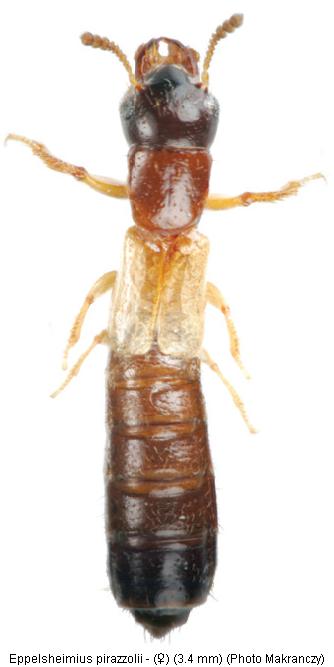
EppelsheimiusSetation behind the front of labrum hyperdeveloped so that the lateral setae reach well beyond four times the length of labrum. Habitus [Abb. 11]
eppelsheimius_pirazzolii_hab.jpg
Abb. 11
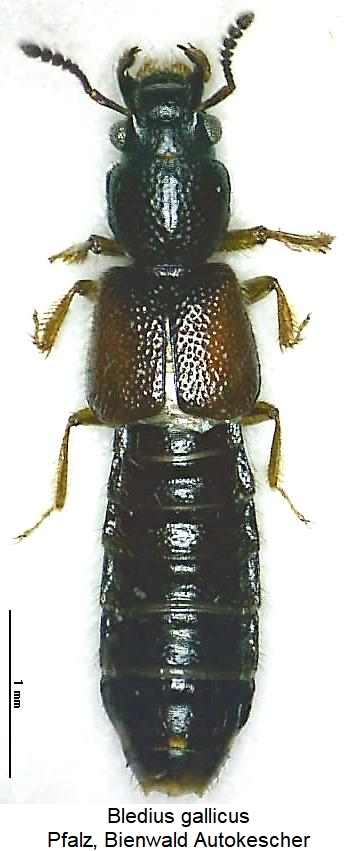
Bledius Leach in Samouelle, 1819-Setation behind the front of labrum is well developed but not reach beyond four times the length of labrum. Habitus [Abb. 12].
bledius_gallicus_hab.jpg
Abb. 12
#14
→ 15Tarsomeres five
→ 25-Tarsomeres less than five
#15
SartallusElytra long, almost entirely covering abdomen
→ 16-Elytra short, abdomen almost fully visible
#16
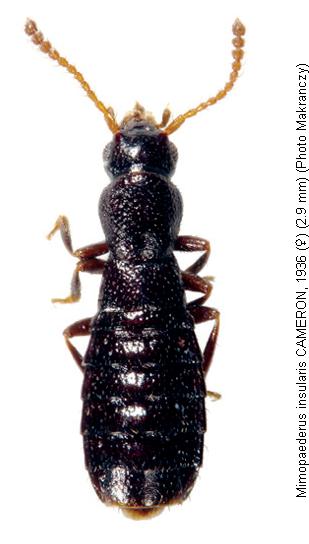
MimopaederusPronotum cylindrical, lateral margins invisible from dorsal view [Abb. 13]
mimopaederus_insularis_hab.jpg
Abb. 13
→ 17-Pronotum with lateral margins always visible from dorsal view
#17
TeropalpusGular sulci narrowly separated anteriorly, more widely posteriorly [Abb. 5]
teropalpus_luniger_kehlnaht.gif
Abb. 5
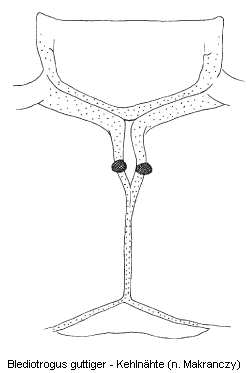
→ 18-Gular sulci fused at least partially [Abb. 14]
blediotrogus_guttiger_kehlnaht.gif
Abb. 14
#18
BlediotrogusGular sulci not fused anteriorly, but merged posteriorly [Abb. 14]
blediotrogus_guttiger_kehlnaht.gif
Abb. 14
→ 19-Gular sulci always fused anteriorly
#19
→ 20Labrum undivided
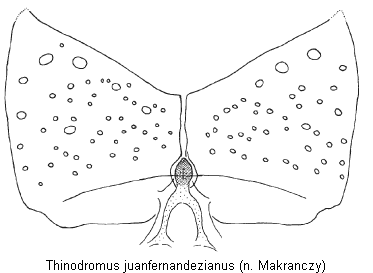
→ 21-Labrum divided along mid-line [Abb. 15]
thinodromus_juanfernandezianus_labrum.gif
Abb. 15
#20
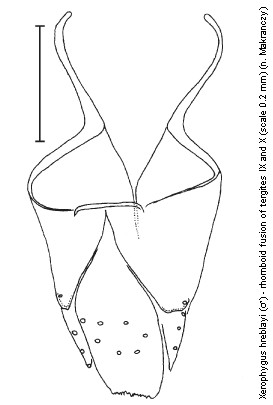
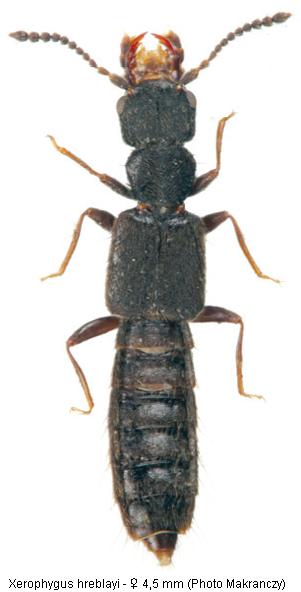
XerophygusBasolateral portions of tergite X fused to tergites IX (rhomboid fusion) [Abb. 16]. Habitus [Abb. 17]
xerophygus_hreblayi_terg.gif
Abb. 16
xerophygus_hreblayi_hab.jpg
Abb. 17
Ochthephilus Mulsant & Rey 1856-Tergite X always complete, unmodified
#21
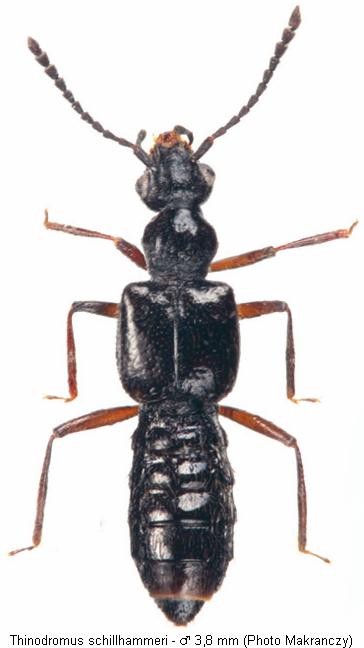
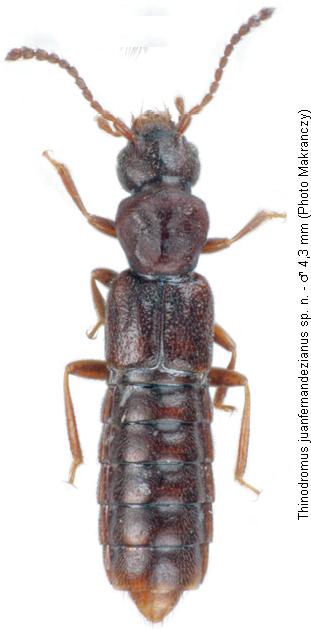
Thinodromus Kraatz 1857Antennae not extremely elongated (mid-antennal segments less than three times as long as broad). Habitus [Abb. 18] [Abb. 19]
thinodromus_schillhammeri_hab.jpg
Abb. 18
thinodromus_juanfernandezianus_hab.jpg
Abb. 19
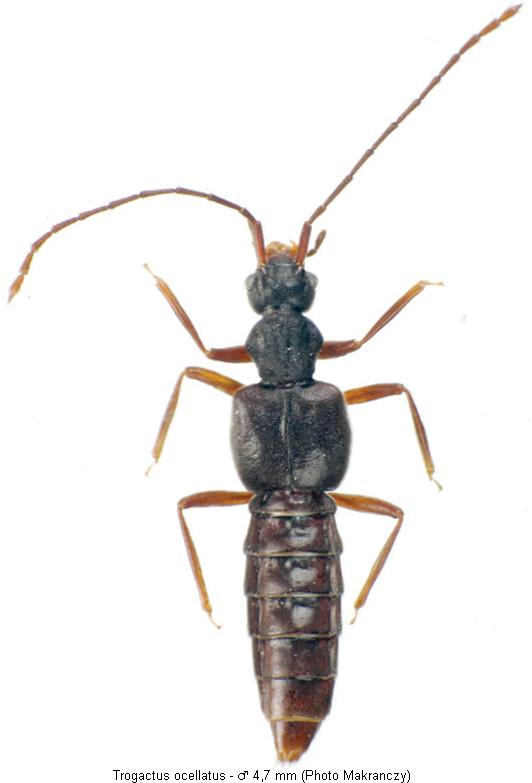
Trogactus-Antennae extremely elongated (mid-antennal segments more than three times as long as broad) [Abb. 20]
trogactus_ocellatus_hab.jpg
Abb. 20
#22
→ 23Tarsomeres four
→ 24-Tarsomeres less than four
#23
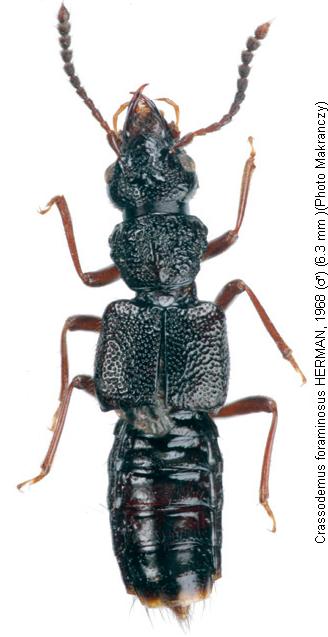
CrassodemusBasal segment of labial palp with strong setation mediad. Distal segment of maxillary palp much longer than penultimate. Habitus [Abb. 21]
crassodemus_foraminosus_hab.jpg
Abb. 21
Pareiobledius-Basal segment of labial palp without such setation. Distal segment of maxillar palp quite reduced, much smaller and thinner than penultimate
#24
→ 25Tarsomeres three.
→ 34-Tarsomeres two.
#25
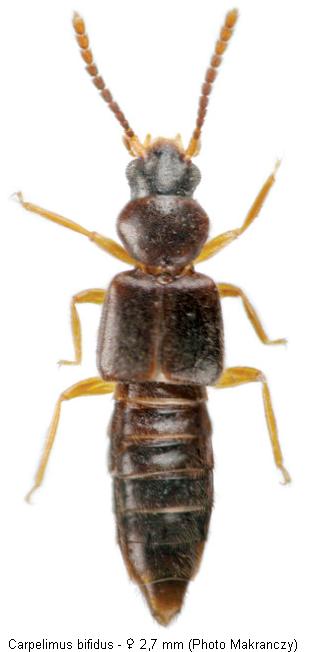
Carpelimus Leach in Samouelle, 1819Basal two tarsomeres strongly compressed. Habitus [Abb. 22]
carpelimus_bifidus_hab.jpg
Abb. 22
→ 26-Basal two tarsomeres not compressed
#26
→ 27Labrum medially divided [Abb. 15]
thinodromus_juanfernandezianus_labrum.gif
Abb. 15
→ 28-Labrum not divided medially
#27
Aploderus Steph.Tergum X not bilobed. Tergal basolateral ridges absent, epistomal sulcus present, sometimes accentuated by dark line
Paraploderus-Tergum X slightly bilobed at apex. Tergal basolateral ridges present, epistomal sulcus absent
#28
ParosusLabrum anteriorly with a very conspicuous rounded incision
→ 29-Labrum without such incision
#29
EcitoclimaxPronotal lateral marginal bead absent
→ 30-Pronotal marginal bead present.
#30
JerozeniaAntennomeres nine
→ 31-Antennomeres eleven
#31
Platystethus Mannh.Elytra slightly overlapping at suture
→ 32-Elytra strictly parallel at suture
#32
Oxytelus GravenhorstScutellar impression distinctly diamond-shaped. Aedeagus with apicomedial hook
→ 33-Scutellar impression different. Aedeagus without apicomedial hook
#33
ApocellusNeck about half as wide as head at temples
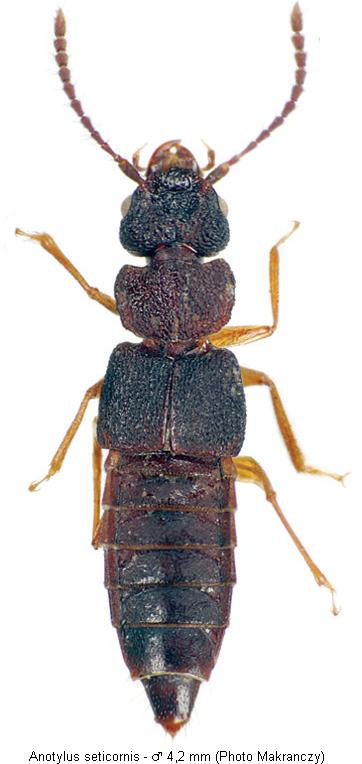
Anotylus Thomson 1859-Neck wider than half of head width at temples [Abb. 23]
anotylus_seticornis_hab.jpg
Abb. 23
#34
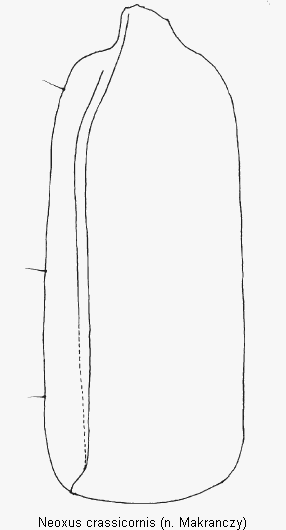
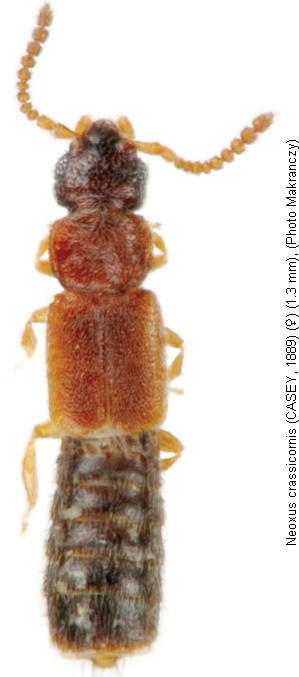
NeoxusElytral epipleural ridge present [Abb. 24]. Hypomeron of pronotum well developed, concealing most of protrochantin [Abb. 25]
neoxus_crassicornis_fld.gif
Abb. 24
neoxus_crassicornis_hab.jpg
Abb. 25
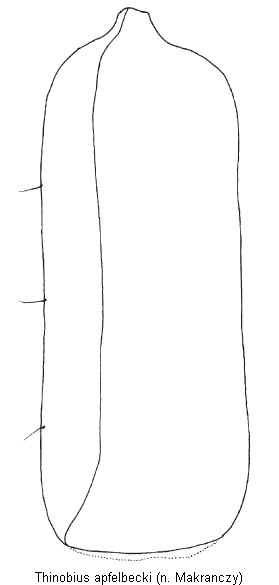
→ 35-Elytral epipleural ridge absent [Abb. 26]. Hypomeron of pronotum less extended mediad; protrochantin visible
thinobius_apfelbecki_fld.gif
Abb. 26
#35
Thinobius Kiesw.Scutellum pubescent (to various degrees)
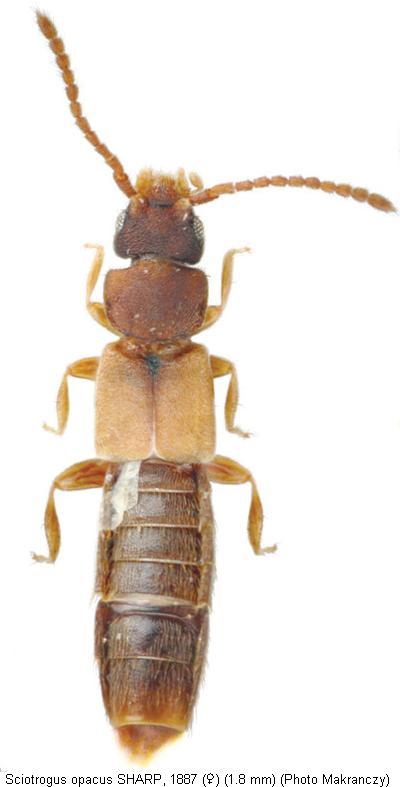
Sciotrogus-Scutellum without pubescence [Abb. 27]
sciotrogus_opacus_hab.jpg
Abb. 27
Enthaltene TaxaAnotylusAploderus Apocellus Blediotrogus BlediusCarpelimusCoprophilusCoprostygnus Crassodemus DeleasterEcitoclimax Eppelsheimius Euphanias Homalotrichus Jerozenia MandaMimopaederus Mitosynum Neoxus OchthephilusOxypius OxytelusParaploderus Pareiobledius Parosus PlaneustomusPlatydeleaster PlatystethusSartallus Sciotrogus SyntomiumTeropalpus Thinobius ThinodromusTrogactus Xerophygus
Erstellt am: 31.08.2010 · Letzte Aktualisierung: 24.07.2022 - 09:30:45
Creative Commons LizenzvertragKäfer Europas herausgegeben von Arved Lompe sind lizenziert unter den Bedingungen der Creative Commons International 4.0 Lizenz BY-SA (Namensnennung-Weitergabe unter gleichen Bedingungen)