Tribus Tachyini Oriental Region according to Andrewes, 1925
Newly arranged by Arved Lompe
Andrewes, H.E. (1925): A Revision of the Oriental Species of the Genus Tachys - Ann. del Mus. Civ. di St. Nat., Vol. 51:327-502 Tafel III-IV >>>https://wallace-online.org/converted/supplementary/specimens/1925_Andrewes_WSPEC201.pdf oder >>>"F:\TAXA\coleo\Scans\_ORR\Andrewes1925 Tachys Orientalische Region.pdf"
Just to have this old key available. It's the original from Andrewes, but pictures added. For an actual version with additional pictures, corrections and taxonomic changes see the German key >>>Tachyini_OR
#2
→ 1r(3) Elytra convex, short-ovate, a quarter to three eighths only longer than wide, border practically smooth, antennae with joints 2 and 3 of equal length. recurvicollis - group.
→ 4-Elytra flat or moderately convex, generally elongate (rarely less than half as long again as wide), border of elytra setulose, antennae with joint 2 longer than 3.
#4
→ 5(7) Stria 8 impressed on apical half of elytron, apical striole present on middle of elytron. Length 1,8 - 4,0 mm.
...1tr-Stria 8 wanting, apical striole wanting or rudimentary (except ochrias). Length 1,0 - 1,8 mm. truncatus - group.
#5
→ 1t(6) Elytra testaceous or piceous, rarely spotted, form depressed and elongate, elytra nearly always more than half as long again as wide. triangularis - group.
→ 1q-Elytra black (except var. lanquidus), with pale spots (except var. impictus), iridescent, elytra moderately convex and about half as long again as wide. quadrillum - group.
#10
→ 11(25) Elytra with two dorsal pores (exceptionally more), basal sulcus of prothorax not having two pores at middle, claws not denticulate.
→ 1h-Elytra with only one dorsal pore, basal sulcus of prothorax with two pores at middle, claws denticulate, form very short and convex. Length 1,5 - 2,5 mm. haliploides - group.
#11
→ 12(24) Stria 8, at least on apical half, and apical striole both present.
acaroides Motch.-Stria 8 and apical striole obsolete, border setulose and dentate. Length 1,5 mm. acaroides - group. One species only.
#12
→ 13(23) Frontal furrows not exceptionally deep, not converging in front and nearly meeting on front margin of clypeus, labrum truncate or moderately emarginate.
fumigatus Motch.-Frontal furrows long and deep, converging in front and nearly meeting on front margin of clypeus, labrum semicircularly emarginate. fumigatus - group. One species only.
#14
...1xp(15) Stria 8 completely interrupted at middle, and represented by large pores in front. expansicollis - group.
...1ex-Stria 8 sub-interrupted at middle, or lightly and irregularly impressed on basal half, with distinct microsculpture. exaratus - group.
#17
...1no(18) Elytra fully striate, the striae punctate or crenulate, form moderately convex. notaphoides - group.
→ 19-Elytra not fully striate (except klugi).
#1r
recurvicollis Andrewes, 1925recurvicollis - group (2) Dorsal pores on inner margin of stria 3 at about a fourth and three fifths.
luxus Andrewes, 1925-Dorsal pores on inner margin of stria 4 at basal fourth and just in front of striole.
#4t
dentatus Andrewes, 1925(5) Hind dorsal pore on inner margin of stria 3 at a third from apex. Lengtb 2,0 mm.
serratus Andrewes, 1925-Hind dorsal pore on outer margin of stria 3 just in tront of the striole. Length 1,9 mm.
#7t
(8) Hind dorsal pore just bebind tbe hook of the striole, border rounded, colour brown with two light spots on each eIytron. Length 2,7 mm. orphninus Andrewes, 1925
impressipennis Motch.-Hind dorsal pore in front of the hook of the striole, border angulate, Colour testaceous. Length 2,0 mm.
#10t
zonatus Andrewes, 1925(11) Shiny, flat, antennae short and pale. Length 2,5 mm.
→ 12t-Sericeous, subconvex, antennae long and dark. Length. 2,75 mm.
#12t
sericans Bates(13) Stria 2 much more lightly impressed than 1.
vixstriatus Bates-Stria 2 hardly less impressed than 1. sericans var.
#16t
→ 17t(33) Elytra not fully stria Ie, border behind SHoulder not, dentate.
delicatus Andrewes, 1925-Elytra fully striate, border behind shoulder dentate. Length 2,0 mm.
#17t
→ 18t(32) Elytra with at least two moderately impressed striae.
cinctus Putz.-Elytra with one stria only, faintly impressed, surface very shiny, colour testaceous, with a black band across elytra. Length 2,5 mm.
#18t
→ 19t(31) Elytra with stria. 3 more or less similar to the others.
lissonotus Andrewes, 1925-Elytra with stria 3 on each side present and converging strongly in front, obsolete behind front dorsal pore, elytra very shiny, with a dark band across middle. Length 2,7 mm.
#20t
→ 21t(27) Base of pro thorax wider than apex, hind angles at least slightly obtuse, elytra with some dark markings, microsculpture present.
impressus Motch.-Prothorax equally contracted at extremities, hind angles right and sharp, elytra testaceous, with three deep striae, no microsculpture present. Length 2,5 mm.
#21t
→ 22t(26) Prothorax sinuate behind, elytra testaceous with a dark band across middle.
opalescens Andrewes, 1925-Sides of prothorax not sinuate behind, elytra brown with a dark cloud on disk. Length 2,75 mm.
#22t
transumbratus Bates(23) Elytra with shallow striae, obsoleto at sides, colour pale testaceous with a very faint dark transverse baad. Length 2,75 mm.
→ 24t-Elytra with fairly deep striae, colour dark testaceous, with a black band across middle.
#24t
incertus Andrewes, 1925(25) Elytra nearly two thirds longer than wide. Length 3,0 mm. triangularis var.
triangularis Nietn.-Elytra less than a half longer than wide. Length 2,75 mm.
#29t
vilis Andrewes, 1925(30) Microsculpture consisting of very fine transverse lines, colour piceous.
pallescens Bates-Microsculpture consisting of wide but evident meshes, colour dingy testaceous.
#35t
cameroni Andrewes, 1925(36) Front dorsal pore on stria 5, border behind shoulder dentate, elytra piceous. Length 2,2 mm.
→ 37t-Front dorsal pore on interval 6, border behind shoulder not dentate, elytra testaceous, though often with a dark cloud on disk. Length 2,8 - 4,0 mm.
#37t
→ 38t(50) Elytra not fully striate, or with the outer striae very faint.
bathyglyptus Andrewes, 1925-Elytra fully striate, elytra dark testaceous red with the whole of the disk brown-black. Length 4,0 mm.
#38t
→ 39t(49) Microsculpture on head between eyes formed by isodiametric or moderately wide meshes.
tropicus Nietn.-Microsculpture on head between eyes formed by fine transverse lines, elytra testaceous, with a dark sericeous cloud. Length 3,0 mm.
#40t
→ 41t(43) Head wide, eyes moderately prominent, inner striae fairly deep, intervals wide.
sundaicus Andrewes, 1925-Head narrow, eyes very fiat, striae fine, intervals narrow.
#41t
euryodes Bates(42) Elytra with four or five impressed striae.
obsolescens Bates-Elytra with two impressed striae.
#45t
→ 46t(48) Basal sulcus with an elongate pore at middle, or with the median line passing through it, elytra not more than two thirds longer than wide, the disk more or less clouded. Length 3,25 - 4,0 mm.
cardoni Andrewes, 1925-Basal sulcus with a rounded pore at middle, elytra three fourths longer than wide, testaceous, with only the suture darker. Length 3,1 mm.
#46t
sericeus Motch.(47) Prothorax about half as wide again as long, stria 2 not interrupted before apex.
prolixus Bates-Prothorax about a third as wide again as long, stria 2 interrupted for some distance before apex.
#2q
cruciger Putz.(3) Flat, two striae only lightly impressed on disk, a shoulder spot present, surface sericeous. Length 2,25 mm.
longulus Andrewes, 1925-Moderately convex, 3 impressed striae on disk, shoulder spot wanting, surface shiny. Length 3,0 mm. plagiatus var.
#6q
plagiatus Putz.(7) Elytra quadrimaculate, the apex dull red but hardly forming distinct spots.
sexmaculatus Andrewes, 1925-Elytra sexmaculate, the apex covered by two fairly large pale spots adjoining each other. plagiatus var.
#10q
quadrillum Schaum(11) Elytra quadrimaculate. The shoulder spot rather large, elongate, sometilmes joining hind spot.
→ 12q-Elytra not quadrimaculate.
#12q
languidus Andrewes, 1925(13) Colour of upper surface wholly testaceous. quadrillum var.
impictus Andrewes, 1925 truncatus Nietn.-Colour of upper surface wholly black. quadrillum var. #1tr truncatus - group (2) Mentum without pores, sutural stria impressed on apical half only, colour brown. Length 1,5 mm.
...3tr ochrias Andrewes, 1925-Mentum with two pores. #3tr (4) Elytra with a distinct apical striole, colour pale testaceous. Length 1,8 mm.
...5tr ...6tr-Elytra without a distinct apical striole, colour dark (except var. decolor). Length 1,0·1,6 mm. #5tr (8) Elytra with stria 1 moderately impressed and reaching base, no appreciable microsculpture.
...9tr brachys Andrewes, 1925-Elylra with stria 1 lightly impressed and not reaching base, microsculpture distinct. #6tr (7) Colour chiefly piceous. Length 1,6 mm.
decoIor Andrewes, 1925 ...10tr-Colour testaceous. Length 1,4 mm. brachys var. #9tr (12) Upper surface not or indistinctly setulose. Length 1,5 mm.
mus Andrewes, 1925 microscopicus Bates-Upper surface distinctly setulose. Length 1,0 mm. #10tr (11) Prothorax equally contracted at extremities, the sides faintly sinuate close to base, the hind angles slightly obtuse.
brunneus Andrewes, 1925 ...2ex-Prothorax with base wider than apex, sides distinctly sinuate before base, hind angles right. #1xp expansicollis - group (4) Surface shiny, 1 dorsal stria only, front dorsal pore close to base.
...5ex ambiguus Andrewes, 1925-Surface a little dull, more than 1 dorsal stria, front dorsal pore at about a third from base. #2xp (3) Black, iridescent, prothorax with its sides not sinuate behind. Length 2,2 mm.
expansicollis Bates gestroi Andrewes, 1925-Black, each elytron with two reddish spots, prothorax with its sides strongly sinuate behind. Length 2,5 mm. #5xp (6) Flavous with black marking on elytra, 2 dorsal striae (at least behind), border of elytra smooth. Length 3,25 mm.
bombycinus Andrewes, 1925-Black with white spots, 3 dorsal striae, border of elytra sotulose. Length 2,7 mm.
#1e
#2e
reticulatus Andrewes, 1925(3) Elytra 3 - striate, surface rather dull, microsculpture of prolhorax isodiametric. Length 2,0 mm.
#3e
loriae Andrewes, 1925(2) Elytra 2-striate, surface moderately shiny, microsculpture of prothorax strongly transverse. Length 2,3 mm.
#5e
→ 6e(14) Border of elytra not dentate.
singularis Andrewes, 1925-Border dentate, elytra 5-striate (at least near base), colour testaceous. Length 1,75 mm.
#7e
luteus Andrewes, 1925(8) Elytra uniformly testaceous, striae clearly punctate, microsculpture of elytra obsolescent.. Length 2,4 mm.
→ 9e-Elytra with a black discal spot, striae crenulate, microsculpture of elytra finely transverse. Length about 3,0 mm.
#9e
rhombophorus Andrewes, 1925(10) Black discal spot on elytra diamond-shaped, extending to sides and apex.
evanidus Andrewes, 1925-Black discal spot on elytra oval, not extending to sides and apex. rhombophorus var.
#12e
exaratus Bates(13) Elytra depressed, two thirds longer than wide, sides parallel, striae clearly impressed.
var. curtus Andrewes, 1925 ...2no-Elytra slightly convex, one balf longer than wide, sides somewhat rounded, striae rather lightly impressed. exaratus #1no notaphoides - group (6) Elytra with outer striae clearly impressed, the striae punctate and moderately deep, basal sulcus interrupted at middle, colour dark castaneous or black.
...7no ...3no-Elytra with outer striae very fine, the striae finely crenulate and not very deep, colour bronze or brown. #2no (5) Eyes flat, elytraI striae rather coarsely punctate, colour castaneous.
micraulax Andr. dulcis Andrewes, 1925-Eyes moderately convex, elytral striae finely punctate, colour black, with two light spots on each elytron, microsculpture present. Length 2,7·3,5 mm. #3no (4) Antennae distinctly dilated at apex, no microsculpture. Length 2,4 mm.
castaneus Andrewes, 1925 notaphoides Bates-Antennae hardly dilated at apex, a distinct microsculpture. Length 3,5 mm. #7no (8) Colour brown, basal sulcus without or with only a vague pore at middle. Length 2,5 mm.
var. callispilotus Bates-Colour bronze, basal sulcus with an elongate pore at middle formed by base of median line. Length 2,1 mm. notaphoides
#3p
→ 4p(10) Prothorax with three distinct pores in middle of basal sulcus, stria 6 wanting.
belli Andrewes, 1925-Prothorax with the three pores in middle of basal sulcus indistinct, a trace of stria 7 opposite front dorsal pore. Length 2,7 mm.
#5p
aratus Andrewes, 1925(6) Elytra black, with a small pale spot at apex.
virgatus Andrewes, 1925-Elytra reddish, with a pale stripe along sides. aratus var.
#8p
vigens Andrewes, 1925(9) Elytra black, each with a large vague reddish spot at apex.Length 3,0 mm. aratus var.
ocellatus Bates-Elytra chestnut, each with a small pale spot on a dark background. Length 2,6 mm.
#13p
→ 14p(16) Prothorax strongly contracted and distinctly sinuate bebind, elytra 5-striate, striae 2-3 much shorter in front than the others, no microsculpture.
→ 17p-Prothorax not or only moderately contracted and barely sinuate behind (except quite close to angles), striae 2-3 not much if at all shorter than the others.
#14p
nitens Andrewes, 1925(15) Dorsal striae not crenulate, basal sulcus of prothorax interrupted and with a pore at middle. Length 2,75 mm.
imperfectus Andrewes, 1925-Dorsal striae crenulate, basal sulcus uninterrupted and without special pore at middle. Length 2,6 mm.
#17p
klugi Nietn.(18) Elytra fully striate, without microsculpture. Length 2,9 mm.
→ 19p-Elytra with not more than 6 dorsal striae, microsculpture present.
#19p
chalceus Andrewes, 1925(20) Elytra with 6 dorsal striae. Length 2,75 mm.
→ 21p-Elytra with not more than 5 dorsal striae.
#21p
→ 22p(26) Elytra with 5 dorsal striae (a trace of 6 sometimes in ornatus).
borneensis Andrewes, 1925-Elytra with 4 dorsal striae. Length 2,9 mm.
#22p
ornatus Apetz(23) Form subelongate, elytra parallel in middle, with two pale spots on each. Length about 3,25 mm.
→ 24p-Form short, ovate, elytra with rounded sides. Length 2,75 mm.
#24p
aeneus Putz.(25) Elytra without spots.
biplagiatus Jord.-Elytra each with an apical spot. aeneus var.
#29p
→ 30p(32) Basal sulcus of prothorax hardly impressed, occupied chiefly by a row of minute pores, widely interrupted and without any pore at middle, elytlral striae rather fine.
papuae Andrewes, 1925-Basal sulcus of prothorax shallow, but distinct, and crenulate, interrupted and with a pore at middle, elytral striae deep. Length 3,0 mm.
#30p
erotyloides Andrewes, 1925(31) Elytra two thirds longer than wide, surface shiny, apical spots small. Length 3,2 mm.
fusiformis Andrewes, 1925-Elytra not more than a half longer than wide, surface dull, apical spots large. Length 3,5 mm.
#34p
bembidiiformis Jord.(35) Elytral striae deep, intervals of equal width, surface glabrous. Length 2,75 mm.
barringtoni Andrewes, 1925-Elytral striae shallow, intervals of unequal width, surface pilose. Length 2,8 mm.
#39p
decoratus Andrewes, 1925(40) Elytra 2-striate, prothorax without carina in hind angles.
unitarius Bates-Elytra 1 striate, prothorax witb small but distinct carina in hind angles.
#42p
fusculus Schaum(43) Elytra 2-striate, no distinct pore at middle of basal sulcus of prothorax, a faint microsculpture present.
florus Andrewes, 1925-Elytra 3-striate, a pore at middle of basal sulcus of protborax, no microsculpture.
#46p
spurcus Andrewes, 1925(47) Colour testaceous, elytra each with two deep crenulate striae. Length 3,25 mm.
→ 48p-Colour piceous, elytra each with two smooth striae. Length 3,25 mm.
#48p
pulcher Andrewes, 1925(49) Elytra each with two large reddish spots.
celebensis Andrewes, 1925-Elytra with reddish spots nearly obsolete. pulcher var.
#52p
→ 53p(55) Basal sulcus of prothorax with a deeply impressed median pore, colour black, with two dark red spots on each elytron.
suturalis Motch.-Basal sulcus of prothorax with a slight narrow pore, colour dark testaceous, with suture of elytra darker. Length about 2.,75 mm.
#53p
psilus Andrewes, 1925(54) Median pore elongate, head with distinct microsculpture. Length 2,75 mm.
unisculptus Andrewes, 1925-Median pore round, head without micosculpture. Length 3,0 mm. nilgiricus var.
#58p
→ 59p(63) Form very convex, elytra more than half as wide again as prothorax, which is strongly contracted and sinuate behind, elylral striae widely placed, coIour black or aeneous, with a vague apical reddish spot.
→ 64p-Form moderately convex, elytra not more than half as wide again as prothorax, which is moderately contracted and sinuate behind, elytral striae fairly close together.
#59p
→ 60p(62) Surface glabrous, elytral striae very deep.
interpunctatus Putz.-Surface of elytra pilose, elytral striae not very deep. Length 2,75 mm.
#60p
triloris Andrewes, 1925(61) Stria 3 diverging outwardly in front, frontal furrows parallel, bead without microsculpture. Length 2,75 mm.
laotinus Andrewes, 1925-Stria 3 not diverging outwardly in front, frontal furrows diverging behind, head with a faint isodiametric microsculpture between eyes. Length 3,0 mm.
#65p
→ 66p(68) Prothorax half as wide again as long, stria 3 distinctly impressed, at least between dorsal pores.
peryphinus Bates-Prothorax only a third as wide again as long, stria 3 formed by a lightly impressed crenulate line, head with isodiametric microscuIpture.
#66p
tetraspilus Solsky(67) Stria 3 extending behind far beyond dorsal pore, apical border of elytra red, head with distinct microsculpture.
gradatus Bates-Stria 3 extending behind barely beyond dorsal pore, the whole apex reddish, head without distinct microsculpture.
#70p
→ 71p(73) Prothorax distinctly sinuate behind, frontal furrows not or indistinctly duplicated.
fuscicauda Bates-Prothorax hardly sinuate behind, frontal furrows distinctly duplicated.
#71p
ceylanicus Nietn.(72) Elytra with two dorsal pores only.
polyporus Andrewes, 1925-Elytra with more than two dorsal pores. ceylanicus var.
#77p
arcuatus Putz.(78) Stria 1 very deep, 2 arcuate, interval 2 very wide at middle, prothorax not more than a third wider than long. Length 3,5 mm.
pictus Andrewes, 1925-Stria 1 moderately, 2 very lightly impressed, not arcuate, prothorax more than half as wide again as long. Length 2,4 mm.
#80p
poecilopterus Bates(81) Stria 2 not extending in front beyond the dorsal pore (front or side view), elytra dark but suffused with red, with two pale spots on each, apical joints of antennae fuscous. Length 2,3 mm.
→ 82p-Stria 2 extending in front beyond the dorsal pore.
#83p
nalandae Andrewes, 1925(84) Black, iridescent, apex of elytra red, antennae pale, sides of elytra rounded. Length about 2,75 mm.
→ 85p-Black, brown, or dark red, with two pale or reddish spots on each elytron, sides of elytra subparallel.
#85p
→ 86p(90) Stria 1 entire, apical joints of antennae dark.
pallidicornis Andrewes, 1925-Stria 1 not reaching base, antennae pale, elytral spots small, pale, and transverse. Length 2,7 mm.
#86p
→ 87p(89) Dark red or brown, elytral spots distinct, antennae rather short, submoniliform. Length about 2,25 mm.
malabaricus Andrewes, 1925-Black with vague dark red elytral spots, antennae long, thick, and black. Length 2,75 mm.
#87p
poecilopterus Bates(88) Dark red, the disk of elytra nearly black, spots small and pale, prothorax equally contracted at extremities.
mediocris Andrewes, 1925-Dark brown, elytra with large light red spots, prothorax with base wider than apex.
#92p
tagax Andrewes, 1925(93) Elytra entirely black, antennae pale testaceous.
→ 94p-Elytra black with two red or testaceous spots on each.
#94p
→ 95p(99) Stria 2, viewed from above, not extending in front far beyond the dorsal pore, antennae more or less testaceous.
constrictus Andrewes, 1925-Stria 2, viewed from above, extending half way from dorsal pore to base, apical joints of antennae fuscous. politus var.
#95p
→ 96p(98) Upper surface without iridescence, stria 3 invisible.
nannodes Andrewes, 1925-Upper surface more or less iridescent, stria 3 (side view) visible between dorsal pores, and even close to base.
#96p
stevensi Andrewes, 1925(97) Striae terminating very abruptly in front, antennae darker towards apex, elytral spots large.
nilgiricus Andrewes, 1925-Striae melting away gradually in front, antennae pale throughout, elytral spots small.
#103p
→ 104p(114) Elytra with dorsal striae deep, 2 arcuate (much nearer to 1 behind than at middle).
vixmaculatus Andrewes, 1925-Elytra with dorsal striae shallow and nearly parallel, the spots on elytra faint, no microsculpture. Length 2,7 mm.
#105p
aspilotus Andrewes, 1925(106) Elytra unicolorous. politus var.
→ 107p-Elytra with reddish spots.
#107p
politus Motsch.(108) Elytra each with an apical spot.
homostictus Bates-Elytra each with an apical and shoulder spot. politus var.
#110p
compactus Andrewes, 1925(111) Upper surface with microsculpture. Length 3,0 mm.
→ 112p-Upper surface without microsculpture.
#112p
gongylus Andrewes, 1925(113) Interval 2 on disk much wider than 1, colour mainly reddish. Length about 2,7 mm.
charactus Andrewes, 1925-Interval 2 on disk not much wider than 1, colour mainly black. Length about 2,9 mm.
#116p
babaulti Andr.(117) Elytra without spot. Length 2,5 mm.
championi Andrewes, 1925-Elytra each with two large pale spots. Length 3,0 mm.
#119p
→ 120p(134) Sides of prothorax sinuate, if at all, close to hind angles, form moderately convex. Length not exceeding 2,8 mm.
eueides Bates-Sides of prothorax strongly sinuate at some little distance from hind angles, form convex, elytra black, quadrimaculate. Length 3,3 mm.
#120p
→ 121p(133) MetasternaI process narrowly bordered, or with a transverse groove behind it, or both.
tostus Andrewes, 1925-Metasternal process unbordored and without transverse groove behind it, elytra dull red. Length 2,1 mm.
#122p
→ 123p(129) Elytra without microsculpture, metasternal process slightly bordered, and with a straight transverse groove behind it.
laetificus Bates-(122) Elytra with a microsculpture of fine Iransverse lines, metasternal process with an arcuate groove behind it. Length 2,5 mm.
#123p
→ 124p(128) Frontal furrows duplicated.
striatifrons Andrewes, 1925-Frontal furrows triplicated, elytra reddish, antennae pale.
#124p
→ 125p(127) Elytral spots pale and fairly distinct, antennae pale, submoniliform.
finitimus Walk.-Elytral spots vague, dull red, antennae filiform, with apical joints fuscous. Length 2,75 mm.
#125p
charis Andrewes, 1925(126) Elytra black, sides of prothorax gently sinuate near hind angles. Length 2,5 mm.
rubescens Andrewes, 1925-Elytra red, sides of prothorax hardly sinuate near hind angles. Length 2,2 mm. charis var.
#131p
javanicus Andrewes, 1925(132) Elytra black, vaguely red on apical half, stria 3 visible from in front.
blandus Andr .-Elytra dark red, stria 3 quite obliterated.
#1c
→ 2ccomptus - group (4) Dorsal pores on stria 3 only.
pluripunctus Andrewes, 1925-Dorsal pores numerous, on striae 3, 5, and 7. comptus var.
#2c
comptus Andr.(3) Two dorsal pores.
borealis Andrewes, 1925-Three dorsal pores. comptus var.
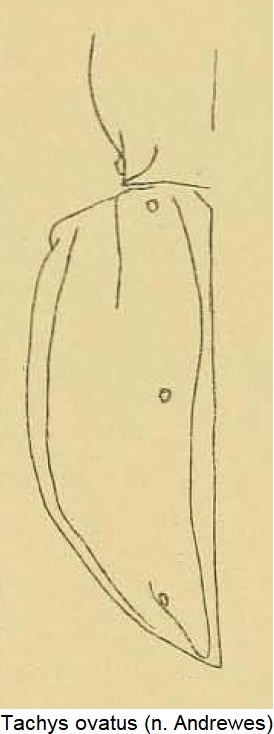
#3o
obliteratus Andrewes, 1925(4) Elytra with rows of few pores on intervals 3 and 5, colour black without spots. ovatus var.
elegans Andrewes, 1925-Elytra with rows of numerous pores on intervals 3 and 5, two reddish spots on each elytron.
#2h
porosus Andrewes, 1925(3) Stria 1 lightly impressed, formed chiefly by punctures, sides of prothorax very sharply rounded, almost angulate, colour piceous. Length 1,5 mm.
→ 4h-Stria 1 deeply impressed, slightly crenulate, sides of prothorax evenly rounded. Length 1,8 - 2,1 mm.
#4h
punctus Andrewes, 1925(5) Elytra with seven dorsal striae, 2 to 7 formed by rather closely placed punctures, colour castaneous.
variabilis Andrewes, 1925-Elytra with six or seven dorsal striae, punctures more distant, very few in outer striae, coIour piceous. punctus var.
#8h
striatulus Andrewes, 1925(9) Elytra with stria 1 distinctly and striae 2 to 5 lightly impressed, colour dark testaceous. Length 2,1 mm.
amplians Bates-Elytra with three impressed and crenulate dorsal striae, 4 just visible on disk, colour light testaceous. Length 1,8 mm.
#14h
→ 15h(17) Elytra testaceous, vaguely darker behind.
unistriatus Putz.-Elytra with apical half darker and a light spot on the darker background. Length 2,1 mm.
#15h
buxans Andrewes, 1925(16) Antennae subfiliform, joints 6 to 8 three times as long as wide. Length 2,5 mm.
bifoveatus Macl.-Antennae submoniliform, joints 6 to 8 not more than twice as long as wide. Length 2,0 mm.
#19h
→ 20h(26) Elytra not more than a third wider than prothorax, stria 1 and dorsal pore only moderately impressed.
glis Andrewes, 1925-Elytra half as wide again as prothorax, stria 1 and dorsal pore very deep. Length 2,0 mm.
#21h
haliploides Bates(22) Antennae rather strongly dilated towards apex, sides of prothorax somewhat explanate behind. Length 2-3 mm.
nanophyes Andrewes, 1925-Antennae only slightly dilated towards apex, sides of prothorax hardly explanate behind. Length 1-6 mm.
#24h
asthenes Andrewes, 1925 haliploides.(25) Head and prothorax brown, elytra mottled with brown, apex piceous. haliploides var.
diversus Andrewes, 1925-Head brown, prothorax red, elytra deep brown, with shoulders and an apical spot testaceous. haliploides var.
#28h
saundersi Andrewes, 1925(29) Elytra with apical third dark red, stria 1 ending very abruptly in front, prothorax distinctly contracted behind.
var. nigrinus Andrewes, 1925-Elytra black, suture and margin sometimes reddish, stria 1 not ending abruptly in front, prothorax distinctly contracted behind. haliploides
#31h
opacus Andrewes, 1925(32) Sutural stria clearly impressed, colour dark testaceous, with head, disk of prothorax, sutural area, and apex of elytra brown. Length 2,5 mm.
bicolor Andrewes, 1925-Sutural stria lightly jmpressed, colour light testaceous, with head and prothorax piceous. Length 1,75 mm. opaeus var.
#3n
nanus Gyllh.(4) Elytra uniformly coloured, dull, with strong isodiametric microsculpture. Length 3,0 mm.
malayicus Andrewes, 1925-Elytra with an apical red spot, shiny, with indistinct transverse microsculpture. Length 2,0 mm.
#6n
→ 7n(9) Elytra with hind dorsal pore on interval 4 or adjacent to stria 4.
wallacei Andrewes, 1925-Elytra with hind dorsal pore on stria 5, quite close to striole, no microsculpture or puncturation. Length 2-4 mm.
#7n
umbrosus Motch.(8) Elytra uniformly coloured (but exceptionally red at apex), prothorax with distinct reticulate microsculpture. Length 3,0 mm.
monostigma Andrewes, 1925-Elytra with apex broadly red, prothorax with only vague traces of microsculpture. Length 2,3 mm.
#11n
coracinus Putz.(12) Elytra uniformly black, median line of prothorax not wider or deeper behind, barely reaching basal sulcus.
acuticollis Putz.-Elytra aeneous black with two white spots on each, median line of prothorax wider and deeper behind, passing through the interrupted basal sulcus.
Enthaltene Taxaacaroides ↧acuticollis ↧aeneus ↧ambiguus ↧amplians ↧aratus ↧arcuatus ↧aspilotus ↧asthenes ↧babaulti ↧barringtoni ↧bathyglyptus ↧belli ↧bembidiiformis ↧bicolor ↧bifoveatus ↧biplagiatus ↧blandus ↧bombycinus ↧borealis ↧borneensis ↧brachys ↧brunneus ↧buxans ↧cameroni ↧cardoni ↧castaneus ↧celebensis ↧ceylanicus ↧chalceus ↧championi ↧charactus ↧charis ↧cinctus ↧compactus ↧comptus ↧constrictus ↧coracinus ↧cruciger ↧decoIor ↧decoratus ↧delicatus ↧dentatus ↧diversus ↧dulcis ↧elegans ↧erotyloides ↧eueides ↧euryodes ↧evanidus ↧exaratus ↧expansicollis ↧finitimus ↧florus ↧fumigatus ↧fuscicauda ↧fusculus ↧fusiformis ↧gestroi ↧glis ↧gongylus ↧gradatus ↧haliploides ↧homostictus ↧imperfectus ↧impictus ↧impressipennis ↧impressus ↧incertus ↧interpunctatus ↧javanicus ↧klugi ↧laetificus ↧languidus ↧laotinus ↧lissonotus ↧longulus ↧loriae ↧luteus ↧luxus ↧malabaricus ↧malayicus ↧mediocris ↧micraulax ↧microscopicus ↧monostigma ↧mus ↧nalandae ↧nannodes ↧nanophyes ↧nanus ↧nilgiricus ↧nitens ↧notaphoides ↧obliteratus ↧obsolescens ↧ocellatus ↧ochrias ↧opacus ↧opalescens ↧ornatus ↧ovatus ↧pallescens ↧pallidicornis ↧papuae ↧peryphinus ↧pictus ↧plagiatus ↧pluripunctus ↧poecilopterus ↧politus ↧polyporus ↧porosus ↧prolixus ↧psilus ↧pulcher ↧punctus ↧quadrillum ↧recurvicollis ↧reticulatus ↧rhombophorus ↧rubescens ↧saundersi ↧sericans ↧sericeus ↧serratus ↧sexmaculatus ↧singularis ↧spurcus ↧stevensi ↧striatifrons ↧striatulus ↧sundaicus ↧suturalis ↧tagax ↧tetraspilus ↧tostus ↧transumbratus ↧triangularis ↧triloris ↧tropicus ↧truncatus ↧umbrosus ↧unisculptus ↧unistriatus ↧unitarius ↧variabilis ↧vigens ↧vilis ↧virgatus ↧vixmaculatus ↧vixstriatus ↧wallacei ↧zonatus ↧
Erstellt am: 31.03.2024 · Letzte Aktualisierung: 19.05.2024 - 01:03:03
 Käfer Europas herausgegeben von Arved Lompe sind lizenziert unter den Bedingungen der Creative Commons International 4.0 Lizenz BY-SA (Namensnennung-Weitergabe unter gleichen Bedingungen)