The Madeiran Trechus belong to the tingitanus group sensu Jeannel. Only two species - fulvus and obtusus, which were imported from the continent, belong to other groups. The unique species from Porto Santo belongs to the monotypic subgenus Atlantotrechus.
#1
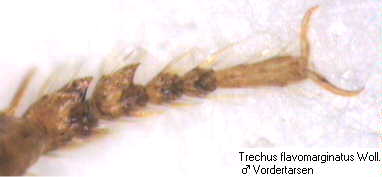
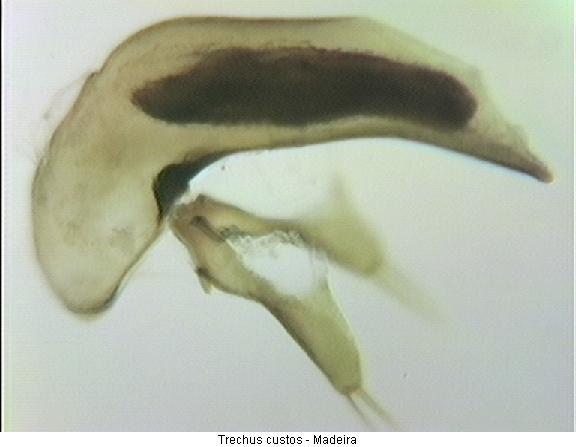
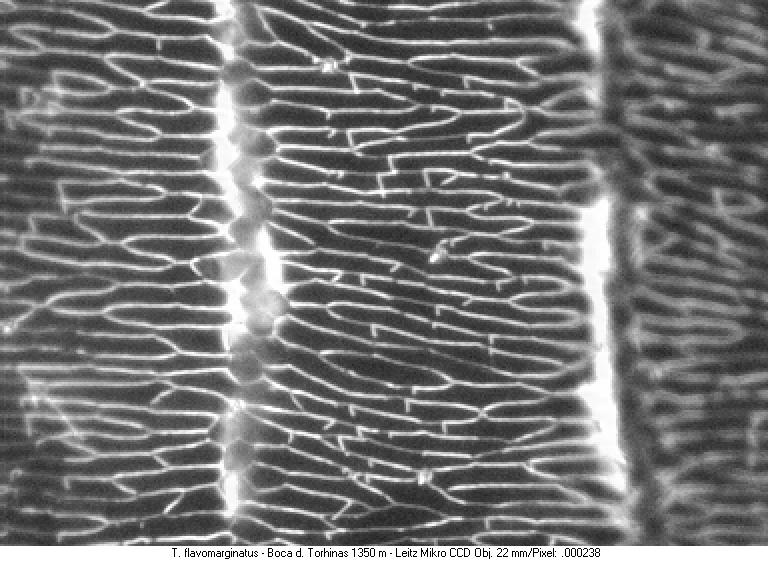
→ 2Male with the two first protarsomeres dilated [Abb. 1]. Eyes either domed and in dorsal view projecting from the outline of the head, or if flat, elytra deeply striate. Pronotum basally with a groove and with +/- distinct impressions or flattened areas near posterior angles. Apex of aedeagus forming an angle with +/- large base of aedeagus [Abb. 2]. Microsculpture of the elytra with transversal meshes [Abb. 3]. (Trechus s. str.)
Abb. 1Abb. 2Abb. 3
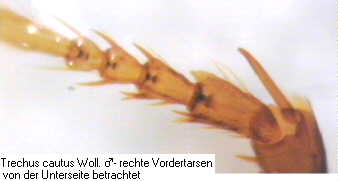
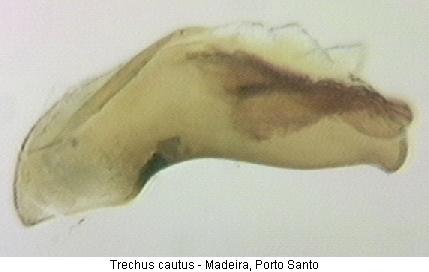
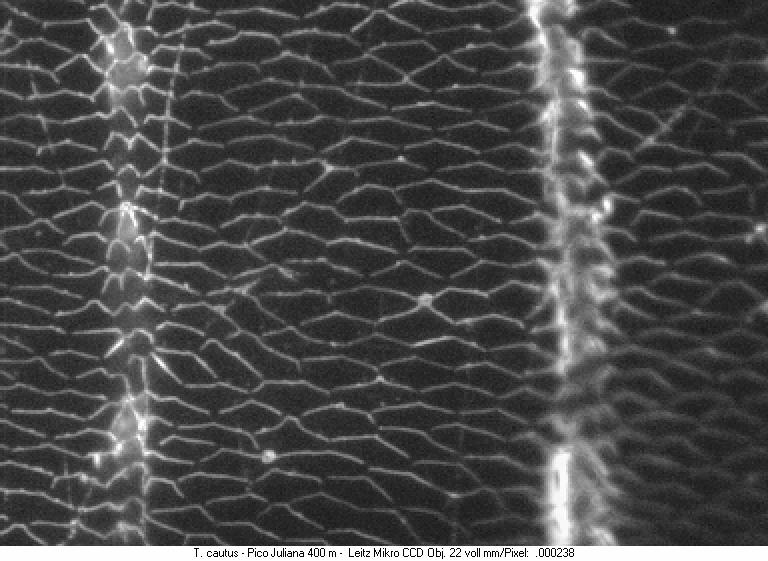
cautus Woll., 1854🗺-Male with only the first protarsomere very weakly dilated, with the inner angle extending into a small process [Abb. 4]. Aedeagus straight, base and apex not forming an angle [Abb. 5]. Eyes flat and large, elytra very finly striate. Microsculpture of the elytra like tiles or scales [Abb. 6]. Subgenus Atlantotrechus Lompe. Only 1 species. Porto Santo.
obtusus Erichson, 1837🗺Posterior angles of pronotum obtusely rounded [Abb. 7]; pronotum rather wide (1,5 x as wide as long), not distinctly two coloured.( ssp. pecoudianus Jeannel cannot be distinguished from the nominal form). Known from the island since 1936. In some places common, therefore it is unlikely that this species has been overseen by the former investigators. Also imported to North America.
Abb. 7
→ 3-Posterior angles of the pronotum somewhat angular [Abb. 8], sometimes very obtuse, but never rounded [Abb. 9]. Pronotum less wide, or, if similarly transverse, sides posteriorly not rounded and posterior angles rectangular.
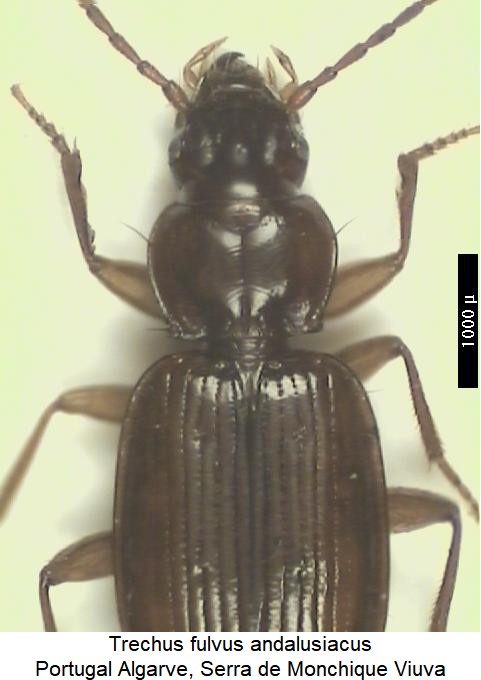
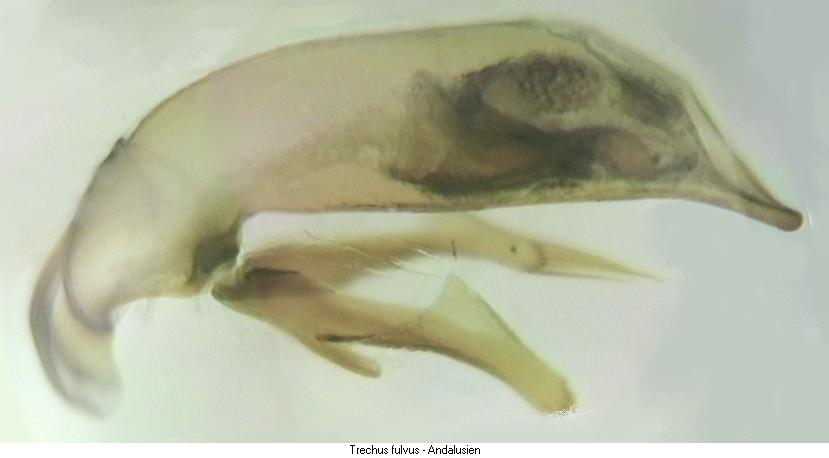
fulvus Dejean, 1831🗺Elytra long, in the middle +/- parallel, with deeply and strongly punctured striae [Abb. 10]. Colour light brown (ssp. madeirensis Serrano & Borges cannot be distinguished from the nominal form). Aedoeagus [Abb. 11]. Known from the island since 1990. Widely distributed along rocky coasts of the Atlantic Ocean from Norway to Maroc; in Spain also at the banks of inland waters.
Abb. 10Abb. 11
→ 4-Elytra oval, sometimes long, but not parallel. Striae at most weakly punctate.
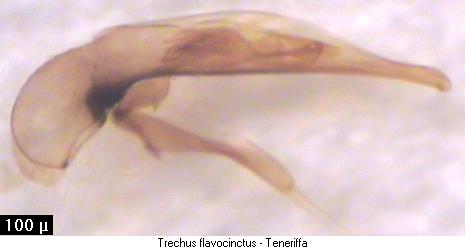
flavocinctus Jeannel, 1922🗺Macroptere (sometimes brachyptere), shoulders protruding, bulged. - A species from the Canary Islands (Teneriffa, Gomera, Hierro). One female newly described as T. lindbergi Colas from Porto Santo. No further specimens known up to date. probabely a confusion of habitat. Aedoeagus [Abb. 12]. (=lindbergi Colas)
Abb. 12
→ 5-Always without wings. Shoulders flat, sometimes a little bit acutely protruding. Endemics of Madeira.
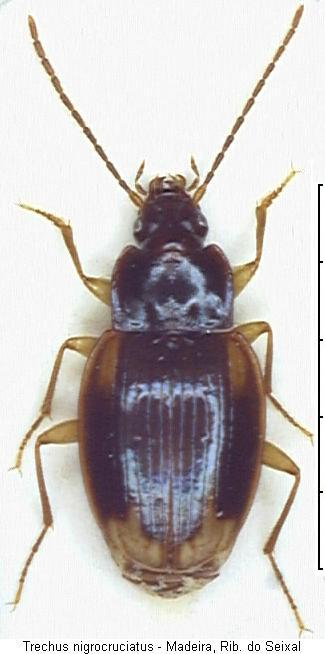
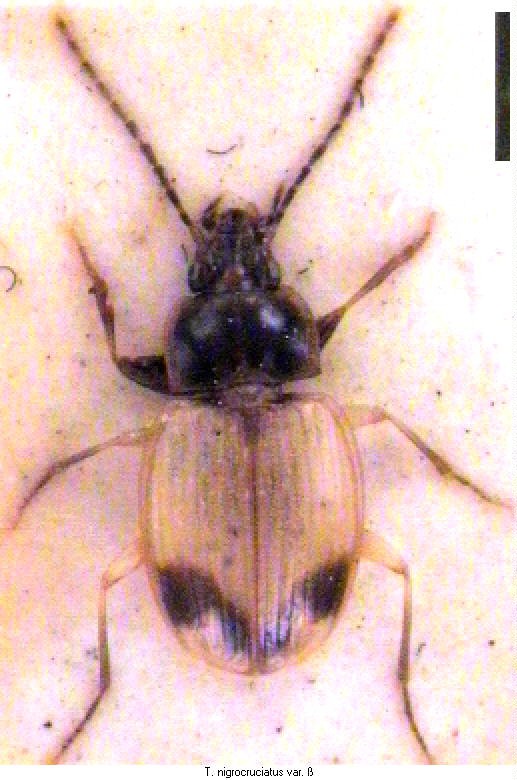
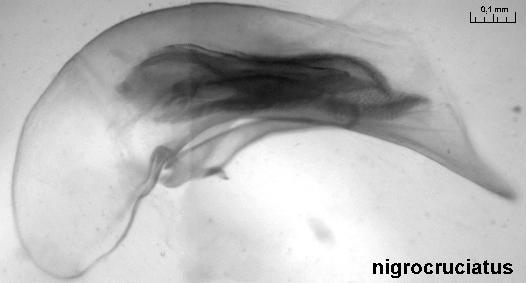
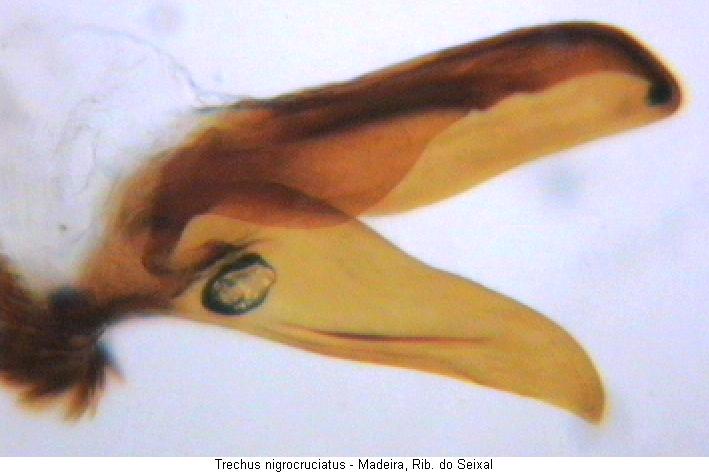
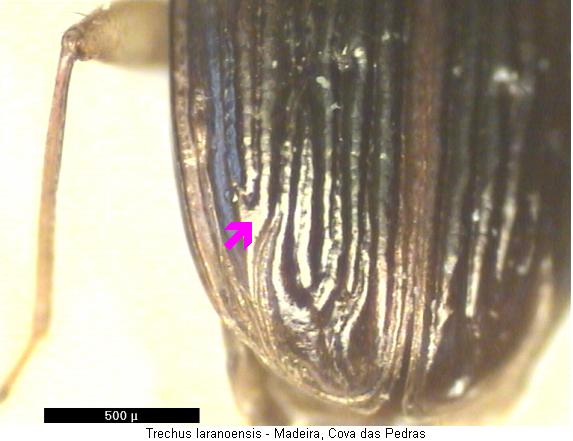
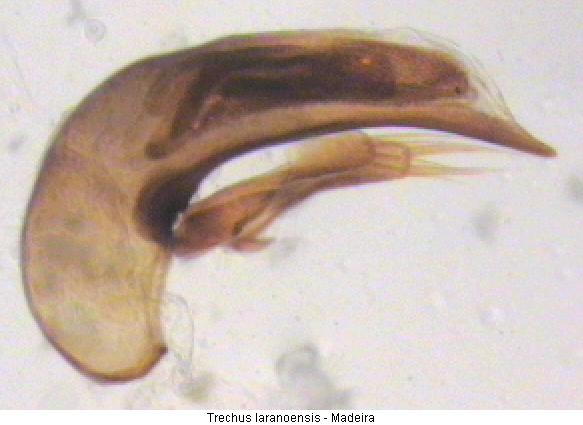
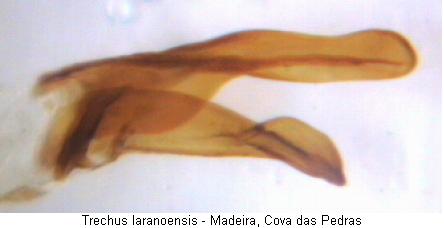
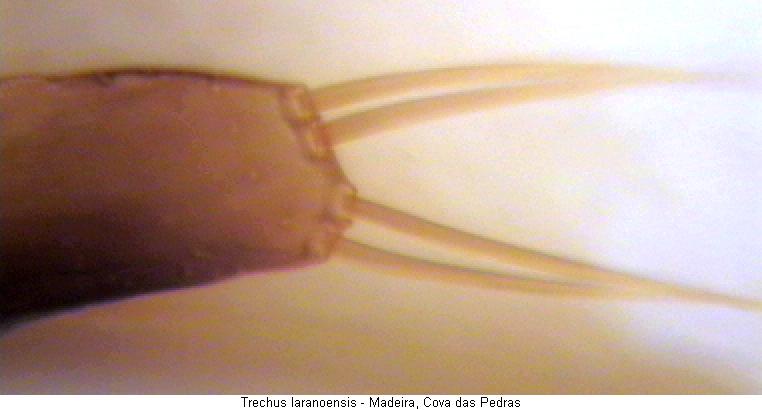
nigrocruciatus Woll., 1854🗺Shoulders and elytral apex yellow. Pronotum remarkably wide, not tapering posteriorly (Amara-like) and with broad lateral margins [Abb. 13]. In Wollaston's collection are also specimens with nearly yellow elytra [Abb. 15] which are not different to the nominal form by genital morphology. Aedoeagus [Abb. 16], Ligula [Abb. 17].
Abb. 13Abb. 15Abb. 16Abb. 17
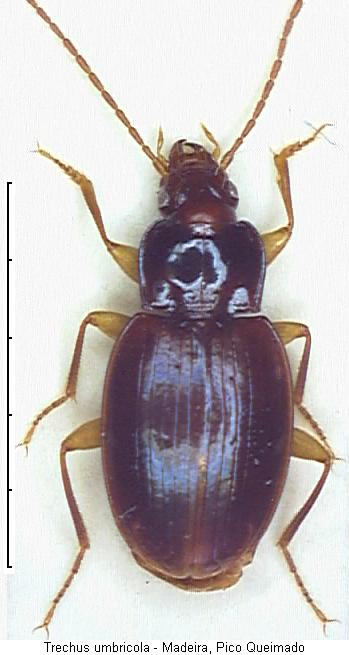
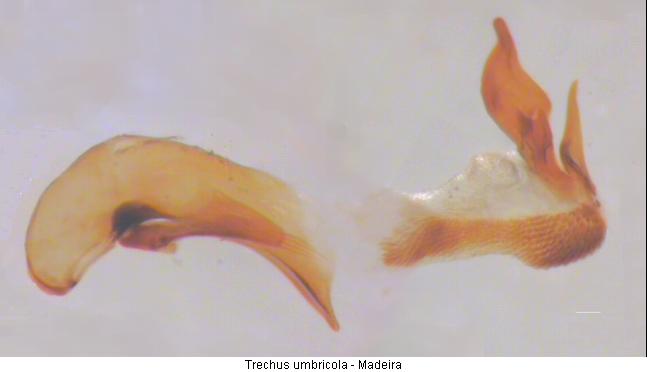
umbricola Woll., 1854🗺-Uniformly coloured, reddish brown to pitchy black [Abb. 18]. Pronotum tapering posteriorly. - Eyes larger, more convex; striae of elytra fine, interstices flat or eyes flat, head therefore narrower. Elytral striae deeper and interstices convex (ssp. wollastoni Jeannel). Very variable. Aedoeagus (with protruded internal sac and typical ligula) [Abb. 19]. (=wollastoni Jeannel) (Note: between this two extreme forms various transitional character states occur. The morphology of the aedeagus, too, is rather variable, but apparently does not correlate with external characters. There is, therefore, considerable doubt that these two forms should be specifically distinct. The type of wollastoni is lost.)
→ 8Head, pronotum and elytra +/- evenly reddish brown to pitchy brown, occasionally with diffuse light spots at the margins of the elytra [Abb. 20].
Abb. 20
→ 15-Elytra distinctly bicoloured [Abb. 14]. At least the elytra with light shoulders; frequently the base and the lateral margins of the elytra yellow, or elytra yellow with dark spots, elytra yellow and apically darkened, or elytra dark with lighter diffuse spots beside the shoulders and at the apex [Abb. 21].
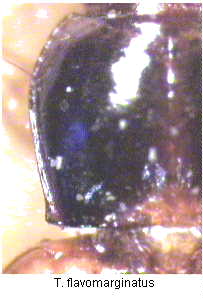
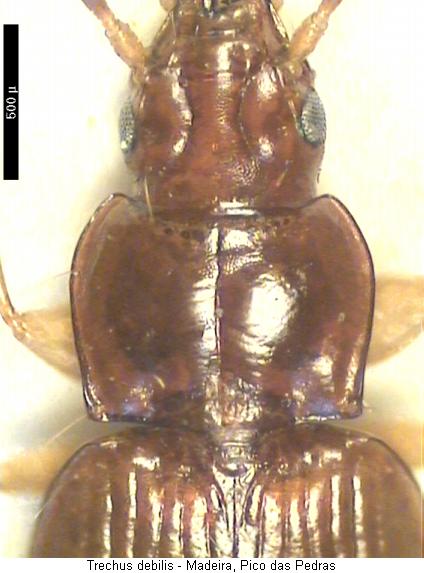
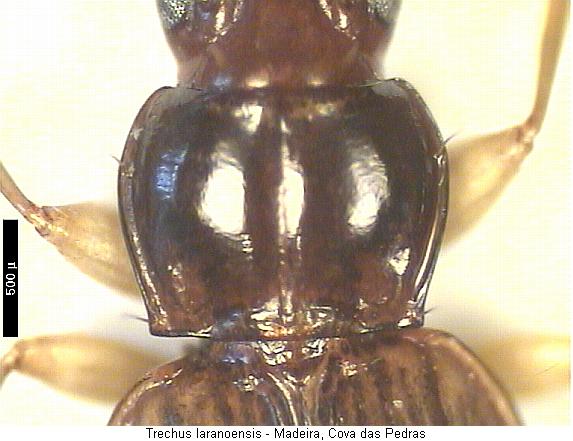
→ 9Pronotum with straight lateral margins, not [Abb. 22] or only weakly narrowed to the base, the base broadly flattened and with rectangular posterior angles [Abb. 23]. Lateral margins of pronotum broad. Elytra deeply striate with convex interstices.
Abb. 22Abb. 23
→ 11-Pronotum with rounded margins [Abb. 24], lateral margins narrow, posterior angles obtuse, the base beside it convex. Elytra less deeply striate, with flat interstices. Elytra with fine microsculpture; the meshes narrow, transverse, 4 to 10 x wider than high.
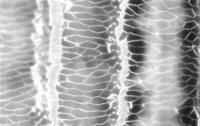
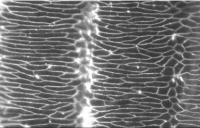
→ 10Eyes small and flat [Abb. 22]. Pronotum posteriorly very weakly narrowed. Antennomeres short. Microsculpture of the elytra coarser, the meshes less transverse, 2 to 3 times wider than high [Abb. 25].
Abb. 22Abb. 25
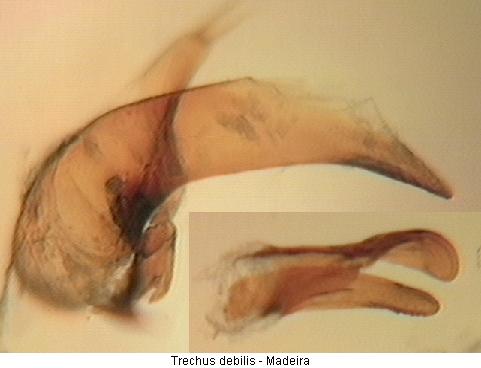
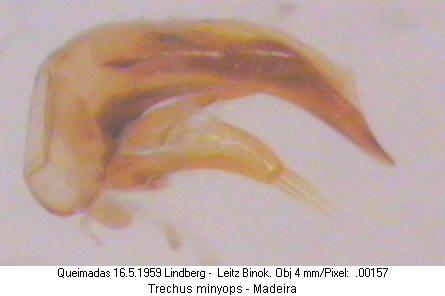
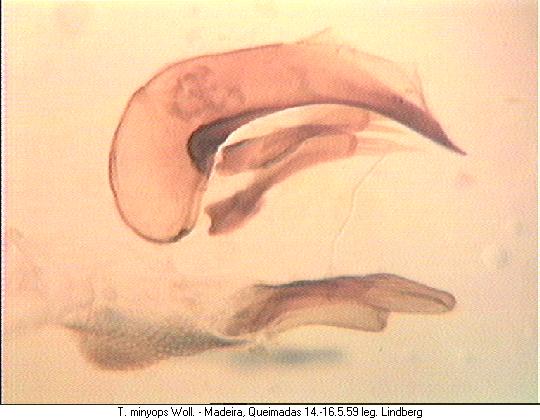
debilis Woll., 1871🗺-Eyes larger, a little bit convex [Abb. 23]. Pronotum posteriorly somewhat narrowed. Antennomeres long. Microsculpture somewhat finer and more transverse, the meshes 4 to 7 times wider than high [Abb. 26]. Tip of aedoeagus weakly curved and the left part of the ligula nearly as long the right part [Abb. 27]
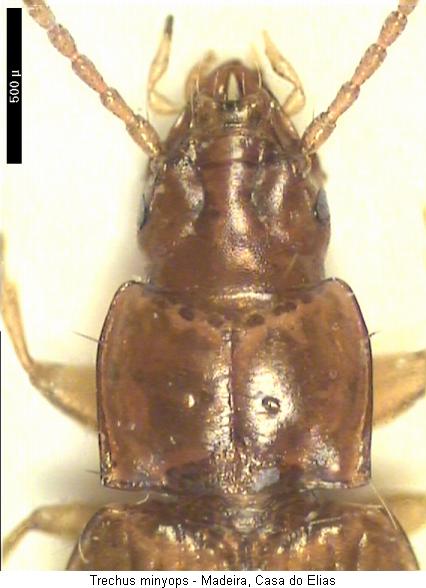
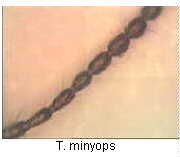
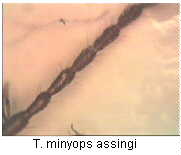
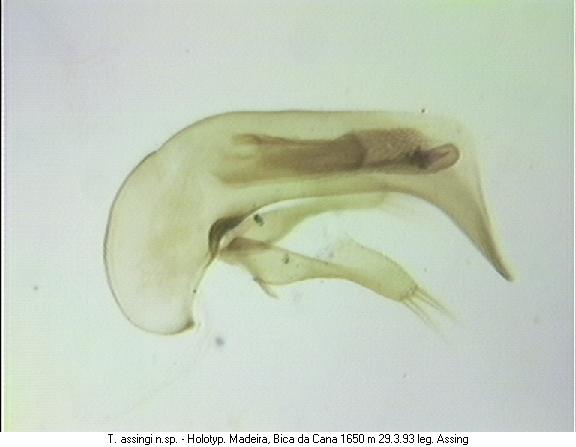
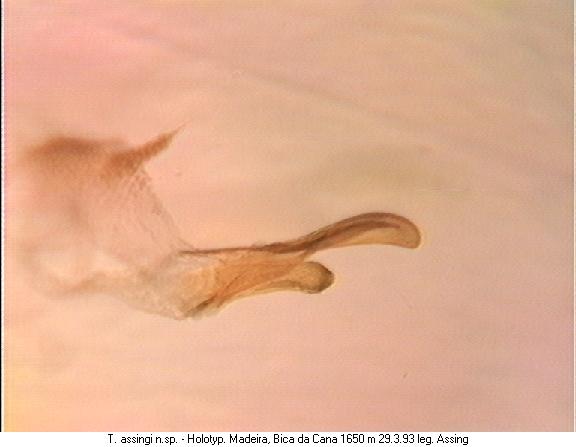
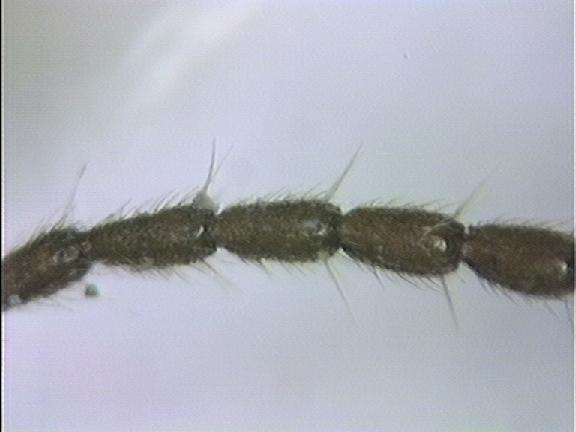
minyops Woll., 1862🗺Antennae short, moniliform. Antennomeres nearly spherical [Abb. 28]. Lateral margin of the pronotum in front of the anterior seta narrow. Apical part of the penis weakly curved [Abb. 29]; the left part of the ligula has 2/3 of the length of the right part [Abb. 30].
Abb. 28Abb. 29Abb. 30
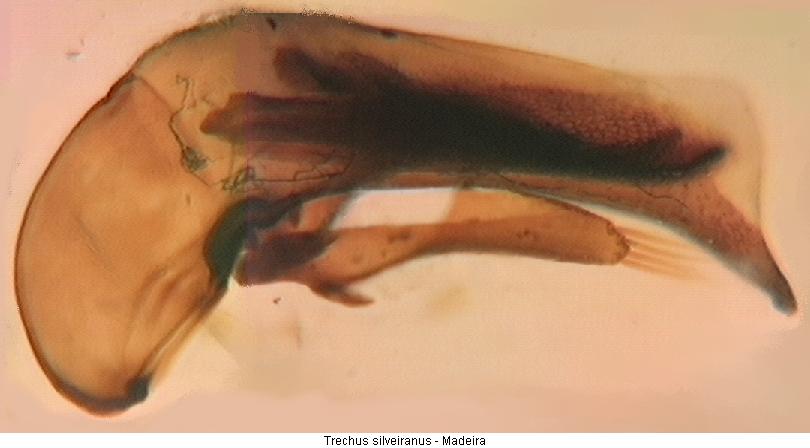
assingi Lompe, 1999🗺-Antennae longer, antennomeres much longer then wide [Abb. 31]. Lateral margin of the pronotum in front of the anterior seta broad. Apical part of the penis stronger curved [Abb. 32]; the left part of the ligula has 1/2 of the lenghth of the right part [Abb. 33].
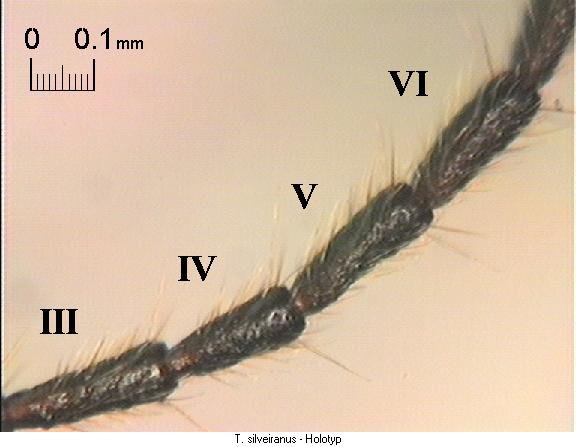
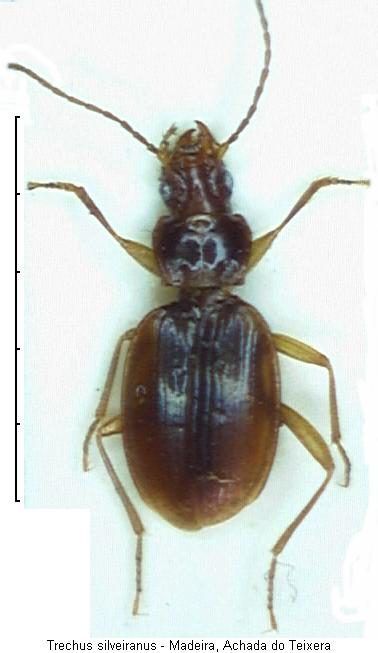
silveiranus Lompe, 1997🗺Large, slim species (> 4,3 mm) with oblong median antennomeres; 2,1 - 2,5 times longer then wide [Abb. 34]. Pronotum small, with broad lateral margins and rectangular posterior angles; lateral margins sinuate in front of posterior angles. Base of elytra strongly convex [Abb. 35]. Aedoeagus [Abb. 36] and Ligula [Abb. 37] large.
Abb. 34Abb. 35Abb. 36Abb. 37
→ 12-Smaller species (< 4,5 mm) or median antennomeres shorter, especially in the females weakly oblong [Abb. 38][Abb. 39]. Elytra relatively shorter and narrower [Abb. 40].
→ 13Pronotum with rounded sides, in front of posterior angles not or very weakly sinuate [Abb. 41]; if the latter is the case, posterior angles pointed [Abb. 42].
Abb. 41Abb. 42
→ 15-Lateral margins of pronotum behind the middle straight or concave, posterior angles distinct [Abb. 43]. Specimens with weak or absent elytral spots of normally bicoloured species.
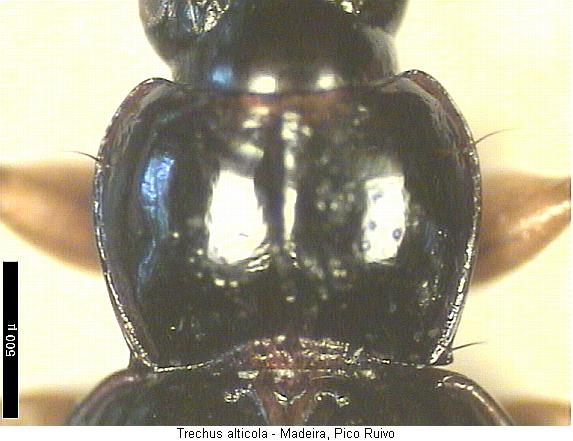
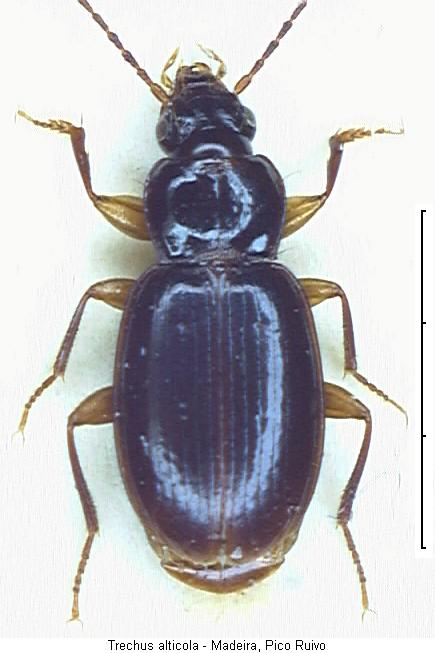
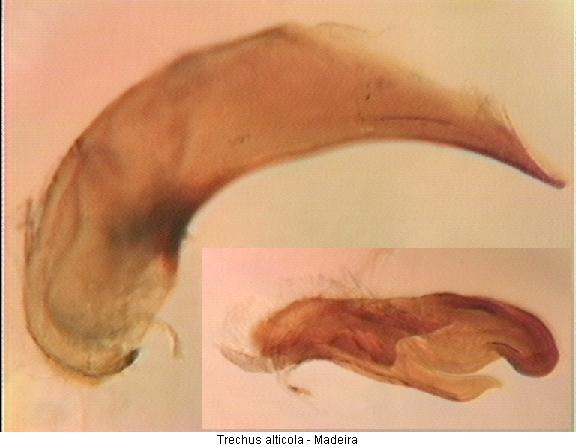
alticola Woll., 1854🗺Dorsal surface shining, elytra with fine striae and flat interstices [Abb. 44]. Tibiae dark or at least distinctly darker than the femora. Posterior angles of the pronotum distinct, acute or rectangular [Abb. 42]. Aedoeagus [Abb. 45].
Abb. 44Abb. 42Abb. 45
→ 14-Elytra with moderately deep striae and convex interstices. Tibiae not distinctly darker than the femora. Posterior angles of the pronotum less distinct, obtuse or rectangular [Abb. 9].
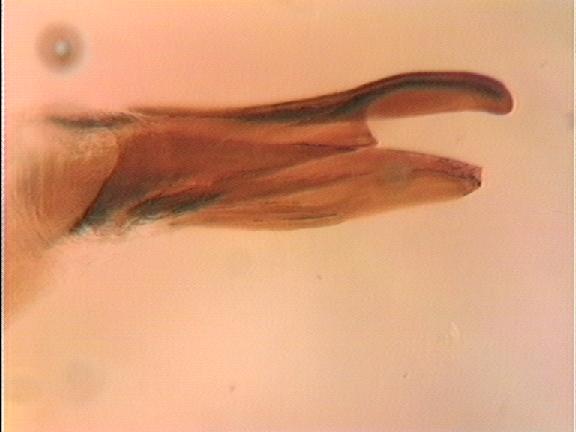
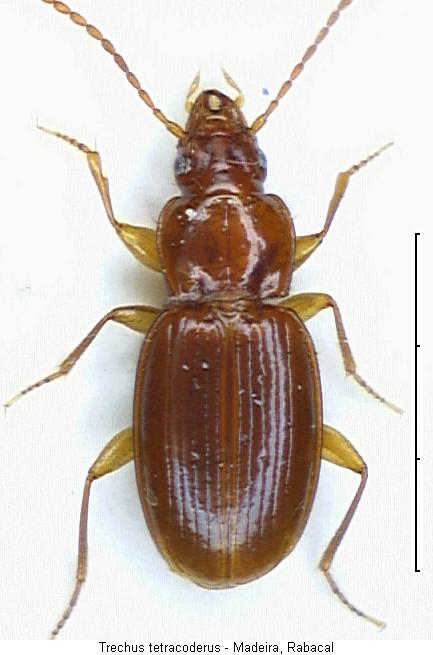
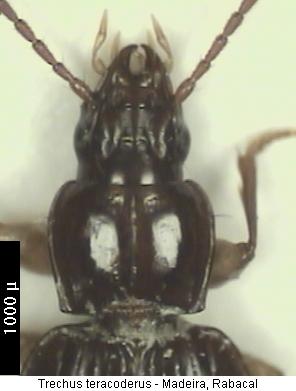
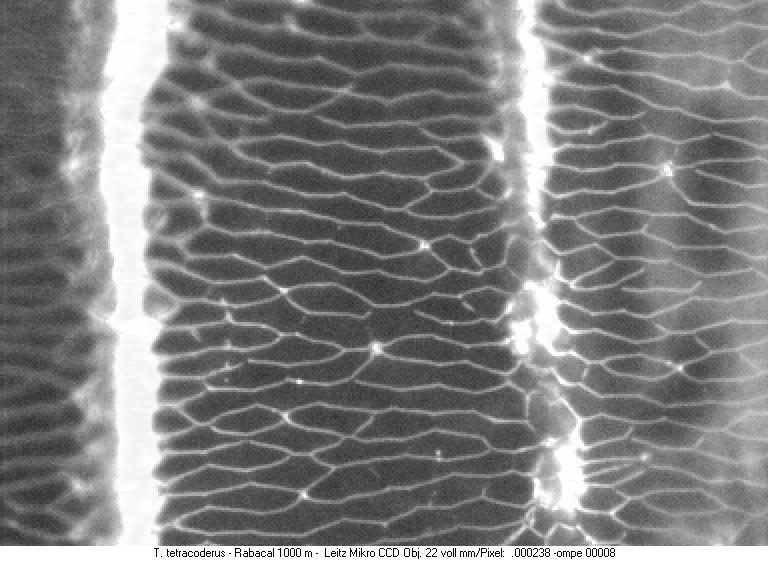
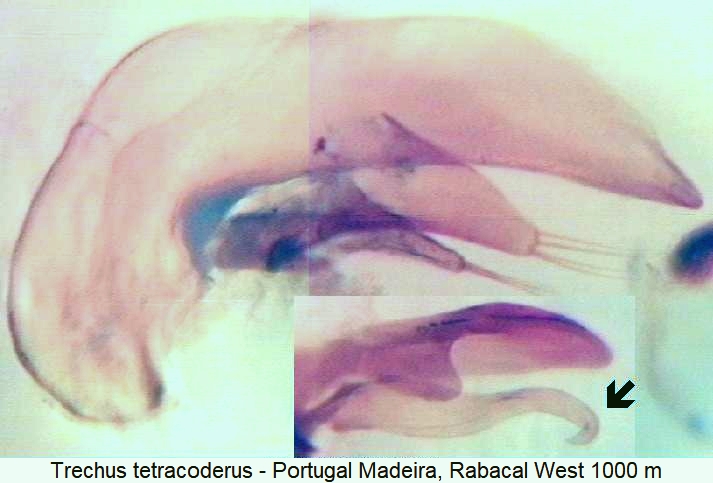
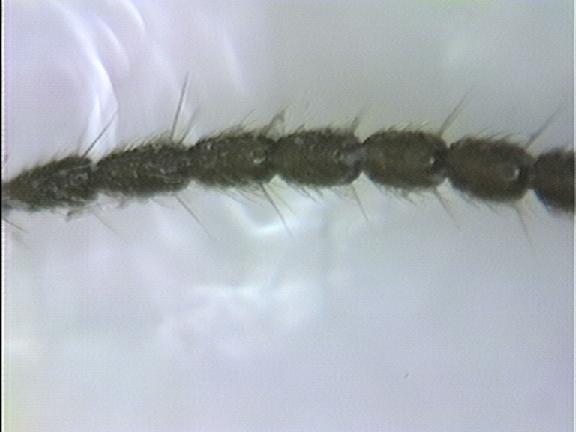
tetracoderus Gemm. et Harold, 1868🗺Large, mostly > 4,5 mm. Males with oblong median antennomeres; 2x longer then wide [Abb. 39]. In facies similar to custos Woll., but distinguished from that species by the narrower space between the gular sutures, the distinctly longer antennae and the less fine microsculpture of the elythra [Abb. 46]. Male: the left part of the ligula forming a hook [Abb. 47].
Abb. 39Abb. 46Abb. 47
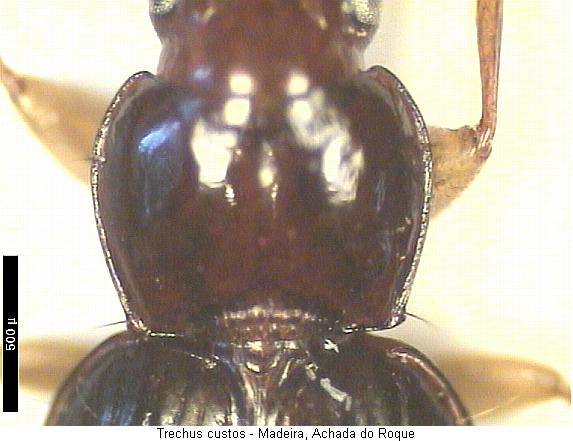
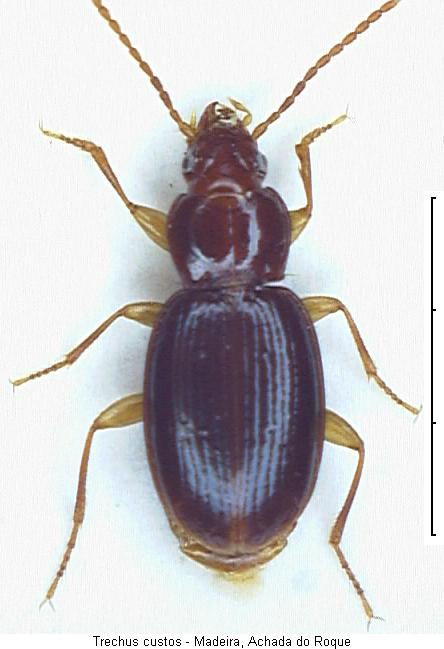
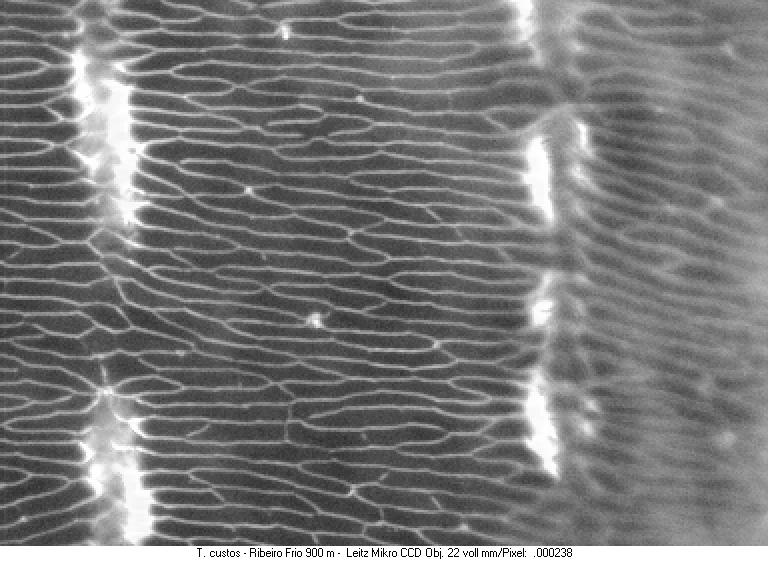
custos Woll., 1854🗺-4 mm and smaller. Median antennomeres shorter [Abb. 38]. Microsculpture of elytra narrower and more traverse [Abb. 48]. Male: the apex of the left part of the ligula straight and acute. This species is very variable and possibly comprises several subspecies. (T. laurisilvae Franz is, in any event, identical to T. custos.). Small specimens of tetracoderus are very similar to custos but can in most cases be well distinguished by the long antennae. (=laurisilvae Franz) Note: Both external characters and the morphology of the genitalia are subject to considerable variation. Without further material available, however, the different forms are here considered an expression of intraspecific variation.
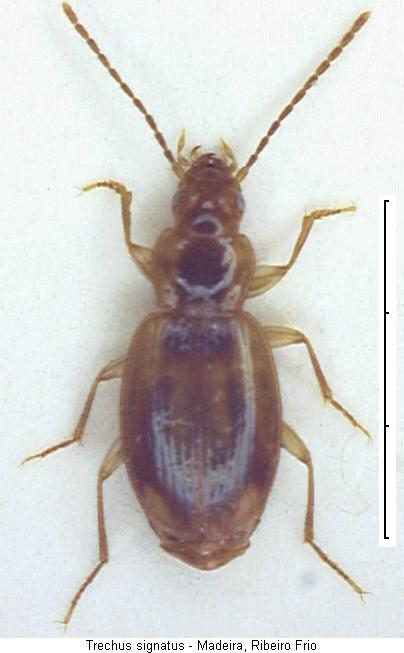
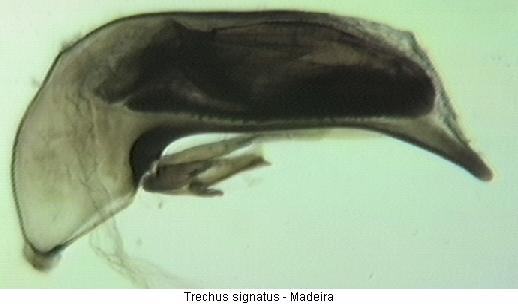
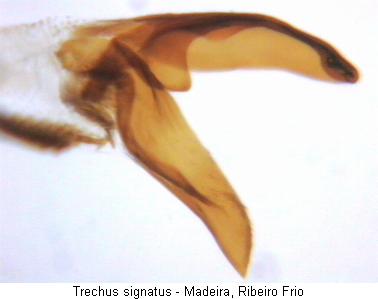
signatus Woll., 1857🗺Remarkably colourful species with obtuse posterior angles of the pronotum. The insect is yellow with dark spots on the forehead, the pronotum and on the elytra; the latter with a dark spot beside the scutellum and an apical U-shaped spot, which is interrupted by a yellow spot beside the Trechus-arc [Abb. 21]. Eyes small and flat. Known only from Ribeiro Frio (where it is apparently common) and San Antonio da Serra (locus typicus). Aedoeagus: [Abb. 49], ligula [Abb. 50].
Abb. 21Abb. 49Abb. 50
→ 16-Less colourful, or if similar in colour, with rectangular posterior angles of the pronotum. Eyes more convex.
→ 17Pronotum with the sides straight [Abb. 43] or distinctly sinuate (cordiform), strongly narrowed posteriorly [Abb. 51]. Hind angles of the pronotum with distinct posterior angles. Striae of the elytra with weak punctation.
Abb. 43Abb. 51
→ 20-Pronotum with the sides straight or weakly sinuate, the base relatively wider, the posterior angles indistinct or weak [Abb. 24].
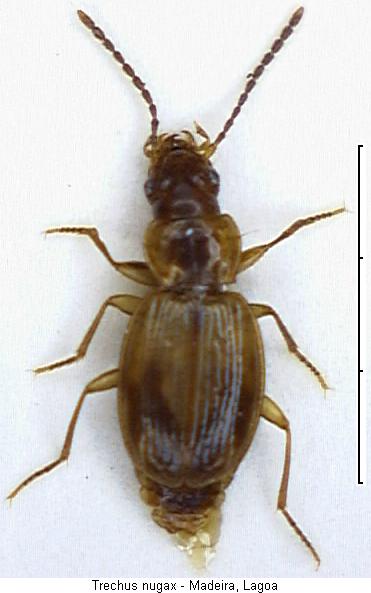
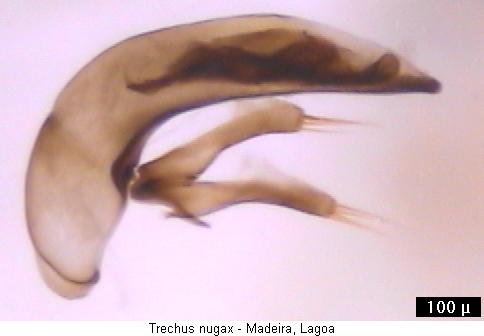
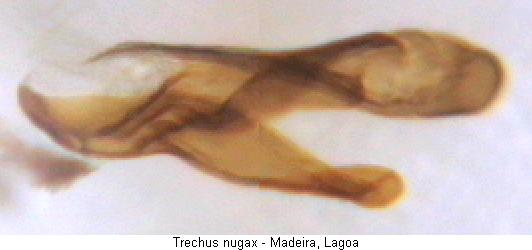
nugax Lompe, 1997🗺Smallest species of the group. Colourful, pronotum yellow and therefore rather similar to signatus. On the elytra no dark spots beside the scutellum. Without light spot near the Trechus-arc [Abb. 62]. Aedoeagus [Abb. 63], ligula [Abb. 64]. - At present, this species is known only from the northwest of the island (northwestern hillsides of Ribeiro da Janela, Fanal). The dilutus-series in the Wollaston collection also contains 1 specimen from Fanal. In the litter of leaves, not only near water.
Abb. 62Abb. 63Abb. 64
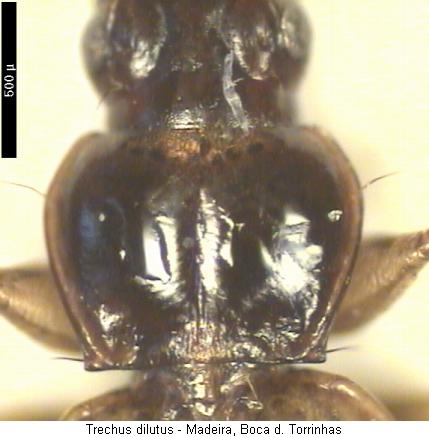
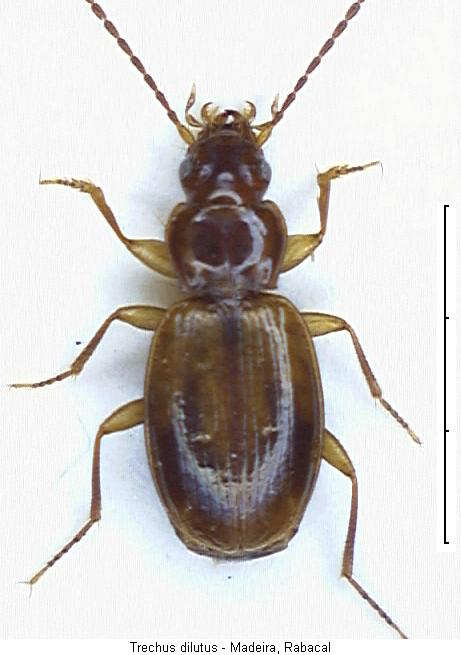
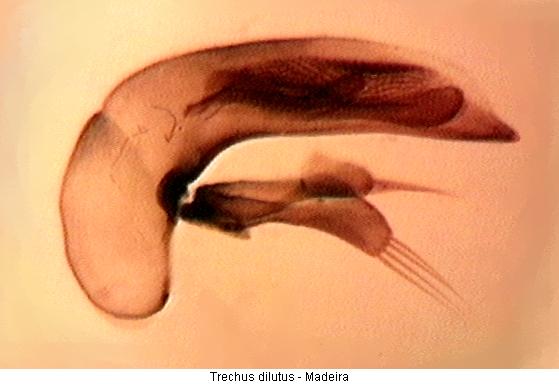
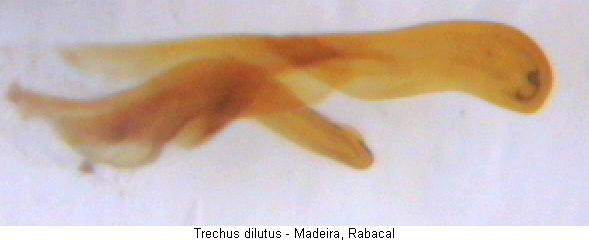
dilutus Woll., 1854🗺-Medium sized species. Variably coloured: distinctly spotted [Abb. 65] or uniformly dark coloured. Pronotum in front of the posterior angles concave [Abb. 51]. Aedoeagus [Abb. 66], ligula [Abb. 67].
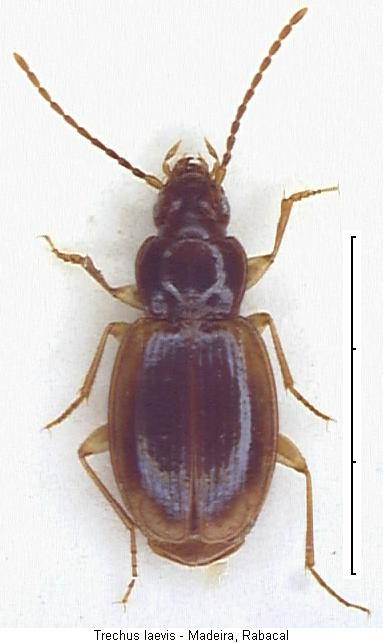
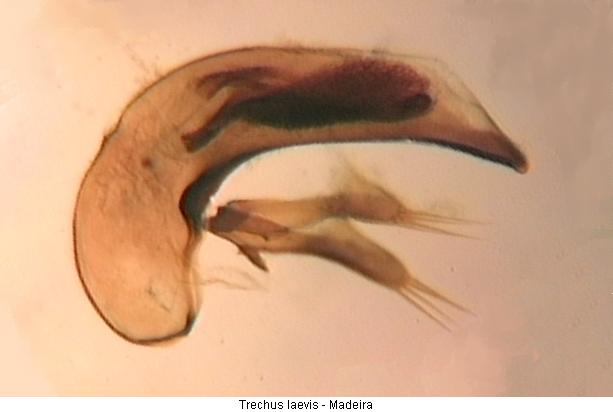
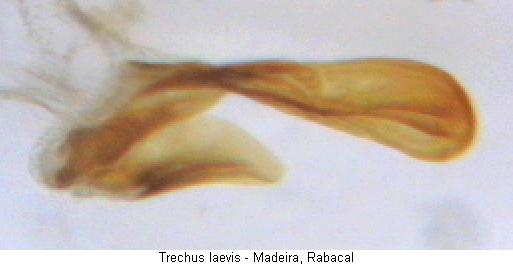
laevis Woll., 1857This and the following species are typically yellow spotted at the shoulders and the apex of the elytra. In most cases this spots are connected by the yellow margin. Posterior angles of the pronotum clearly separated by a short concavity, the posterior quarter of the margin straight or concave. elytra with fine striae and rather flat interstices [Abb. 68]. The light-coloured margins always well-defined and usually wider than in the following species. Elytra broadly oval, length : width usually < 1,3 :1. Aedoeagus [Abb. 69], ligula [Abb. 70].
Abb. 68Abb. 69Abb. 70
→ 21-Posterior angles of the pronotum less distinct. Elytra with deeper striae and more convex interstices [Abb. 14]. Elytra more slender, length : width usually 1,3 : 1. Aedoeagus and ligula different.
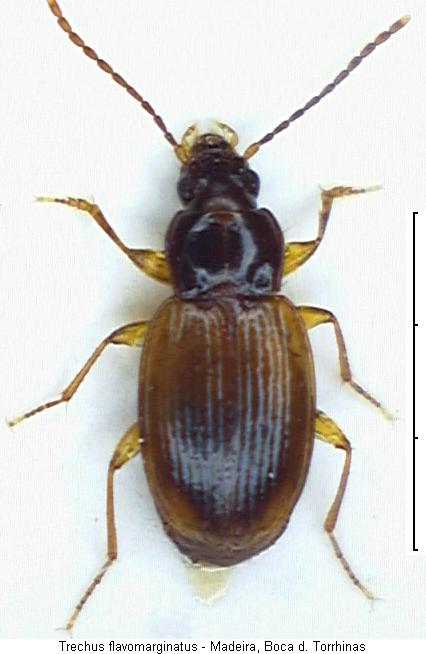
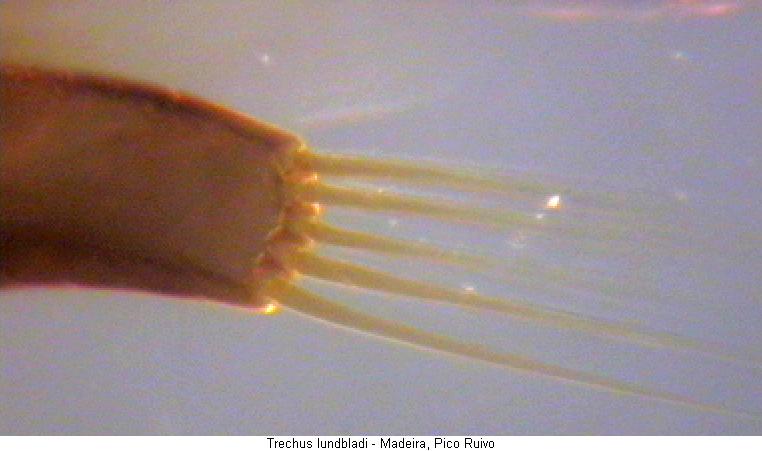
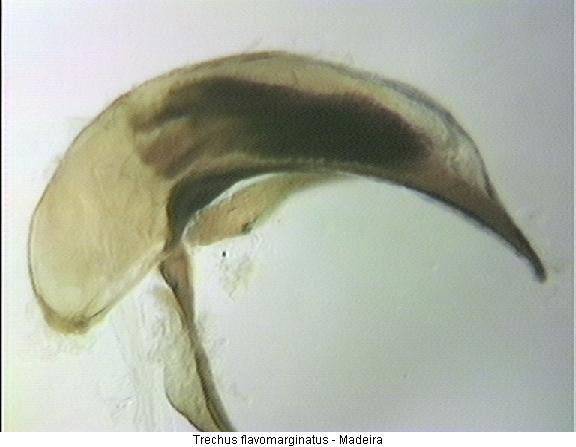
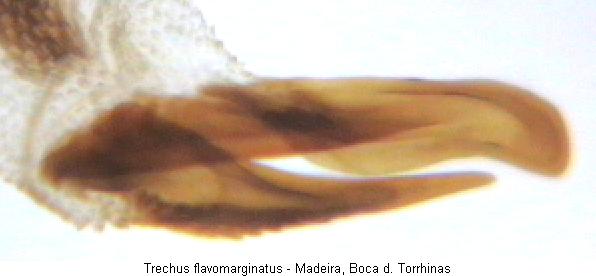
flavomarginatus Woll., 1854🗺The striae of the elytra and the convexity of the interstices are more distinct than in laevis and weaker than in decolor. The striae become weaker to the sides, the 6th and 7th distinctly weaker than the 5th, the 7th stria behind the shoulder +/- obsolete. Elytra dark and with light margins, which are broadened at the shoulders and the apex. Rarely the whole elytra are +/- yellow, posteriorly darkened or with a dark spot. The light-coloured areas more well-defined than in decolor. This species is more slender than laevis, but less so than decolor. It is intermediate between laevis and decolor regarding the striae of the elytra and general proportions, though very similar in colour. Aedoeagus [Abb. 71], ligula [Abb. 72].
Abb. 71Abb. 72
→ 22-Elytra deeply striate with convex interstices and in this respect similar to debilis, but with the microsculpture distinctly finer. The 7th stria of the elytra a little weaker than the 5th, distinct near the shoulder, not or only a little weaker than behind the middle. Similarly coloured as the preceding species, but the light-coloured area at the base less well-defined, the light margin at the apex always very well-defined. Rarely the base of the elytra yellow to light brownish, gradually darkened from the middle to the apex, resulting in a diffusely dark apical spot. Pronotum sometimes light red. Aedoeagus and ligula different.
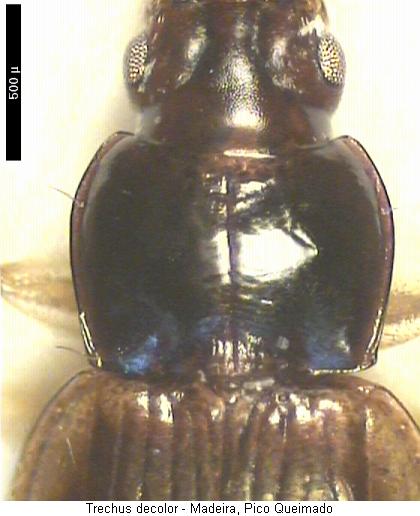
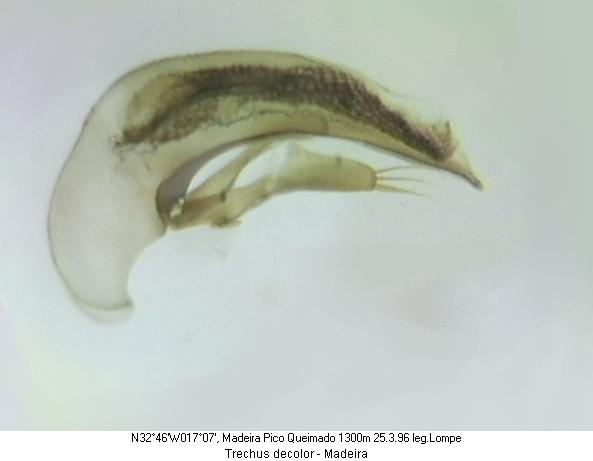
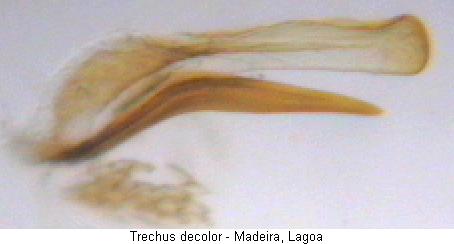
decolor Jeannel, 1938🗺The 7th stria of the elytra a little weaker. The male has less spines around the praeputial sac, the cushion of spines is interrupted [Abb. 73]. The orifice of the phallobasis is concave; the left 'piece copulatrice' straight and longer [Abb. 74]. (Note: This species was originally described as a ssp. of debilis, but is not closely related to this species.)
Abb. 73Abb. 74
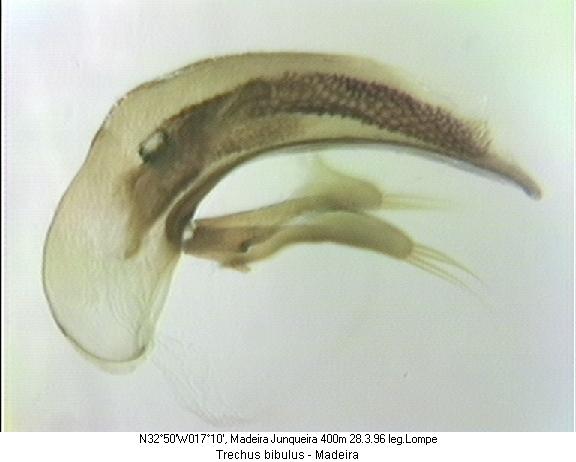
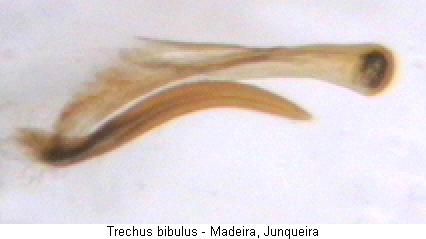
bibulus Lompe, 1999🗺-A very similar form, hardly to distinguish from the former, the 7th stria of the elytra a little stronger. Difference of the aedoagus: praeputial sac with more extended cushion of spines, not iterrupted [Abb. 75]. Orifice of the phallobasis flaf and left 'piece copulatrice' shorter, base and tip forming an angle in the middle [Abb. 76]. Living at the left hillside of the valley of Ribeira da Janela.
 🗺
🗺 -Male with only the first protarsomere very weakly dilated, with the inner angle extending into a small process [Abb. 4]. Aedeagus straight, base and apex not forming an angle [Abb. 5]. Eyes flat and large, elytra very finly striate. Microsculpture of the elytra like tiles or scales [Abb. 6]. Subgenus Atlantotrechus Lompe. Only 1 species. Porto Santo.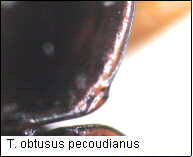





 Käfer Europas herausgegeben von Arved Lompe sind lizenziert unter den Bedingungen der Creative Commons International 4.0 Lizenz BY-SA (Namensnennung-Weitergabe unter gleichen Bedingungen)